Belt Technologies Logo

Custom Metal Drive Belt Solution for Cryogenic Microscopy Equipment

Recently, a microscopy and imaging equipment OEM for the life sciences industry contacted Belt Technologies, Inc. for a solution to a design issue. One of their devices included a small saw for cutting and preparing biological samples in a cryogenic environment. The customer was seeking a durable belt material that would be able to drive the motion of the saw without being affected by the freezing temperature.

Metal Drive Belt Provides Seamless Motion for Cryogenic Saw

The saw would be operating in a cryogenic environment cooled to 196°C with liquid nitrogen. The cold temperature is necessary for the preservation of sensitive biological samples. Previous belt materials, including a toothed polymer belt, had been unable to withstand breaking in the freezing cold. The customer had worked with Belt Technologies before and felt certain that our team of experienced engineers would be able to provide them with a working solution.

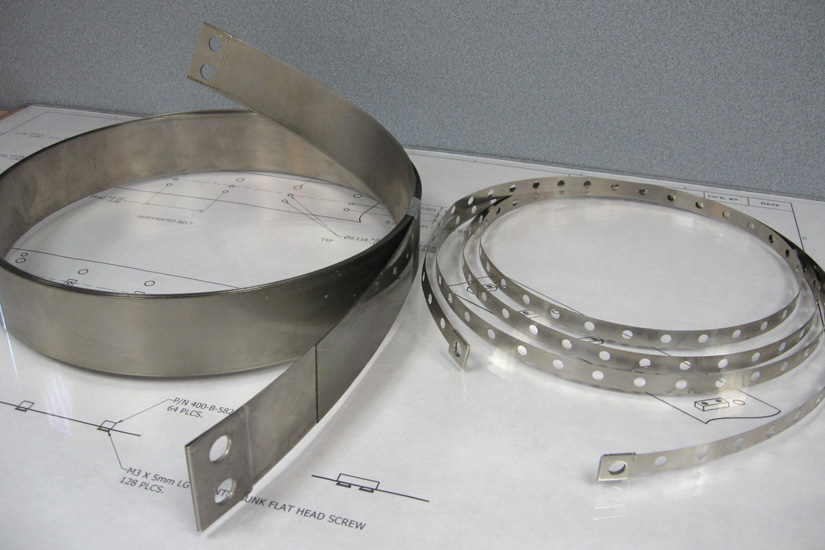
Belt Technologies designed and produced a stainless steel drive belt to drive the motion of the cryogenic saw. Stainless steel has a high resistance to extreme temperatures, giving the belt the necessary resilience to withstand the cryogenic environment. The metal drive belt also provides reliable, accurate motion with virtually no slippage.

Sanitary Stainless Steel Is an Ideal Solution for Life Sciences Automation

In life science equipment, accuracy and reliability are key design aspects that can have a profound impact on the effectiveness of the product. Design elements must also be sanitary, easy to clean, and highly resistant to corrosion.

Stainless steel is the optimal material choice for medical and life science equipment. It is highly resistant to corrosion and does not require lubrication or generate particulates. Easy to keep clean, stainless steel provides a sanitary, impermeable surface that helps prevent the spread of contaminants or disease. In spaces where maintaining sanitary conditions is paramount, such as clean rooms, hospitals, and laboratories, stainless steel is the ideal component material for critical equipment.

Metal Belts Provide Flexible Solutions for Unique Challenges

Applications for metal belts in life science equipment are versatile and numerous. Our team of experts solve automation challenges and provide medical equipment OEMs with innovative and reliable solutions. Contact Belt Technologies today and find out how metal belts can improve the safety and quality of your medical device.
 

Kundenspezifische Metall-Antriebsbandlösung für eine kryogene Mikroskopie-Umgebung

Kürzlich kontaktierte ein Erstausrüster für Mikroskopie- und Bildgebungsausrüstung für Biowissenschaften Belt Technologies Inc. hinsichtlich einer Lösung für ein Design-Problem. Eines seiner Geräte beinhaltete eine kleine Säge zum Schneiden und Vorbereiten biologischer Proben in einer kryogenen Umgebung. Der Kunde suchte nach einem haltbaren Bandmaterial, das für die Bewegung der Säge sorgt, ohne von der Gefriertemperatur beeinträchtigt zu werden.

Metall-Antriebsbänder sorgen für eine nahtlose Bewegung der Kryogenik-Säge

Die Säge sollte in einer kryogenen Umgebung arbeiten, die mit flüssigem Stickstoff auf 196°C gekühlt wird. Die tiefe Temperatur ist für die Konservierung der empfindlichen biologischen Proben erforderlich. Zuvor eingesetzte Bandmaterialien, einschließlich eines Polymer-Zahnriemens, konnten den Gefriertemperaturen nicht widerstehen und brachen. Der Kunde hatte bereits zuvor mit Belt Technologies gearbeitet und war überzeugt, dass unsere Team erfahrener Techniker in der Lage sein würde, eine funktionierende Lösung bereitzustellen.

Belt Technologies entwickelte und fertigte ein Edelstahl-Antriebsband, um die Bewegung der Säge in der kryogenen Umgebung zu gewährleisten. Edelstahl ist sehr widerstandsfähig gegenüber extremen Temperaturen und gibt dem Band die nötige Elastizität, um der kryogenen Umgebung zu widerstehen. Das Metall-Antriebsband sorgt auch für eine zuverlässige, präzise und praktisch schlupffreie Bewegung.

Hygienischer Edelstahl ist eine ideale Lösung für die Automatisierung in den Biowissenschaften

Bei Ausrüstungen für die Biowissenschaften sind Präzision und Zuverlässigkeit wichtige Design-Aspekte, die einen tiefgreifenden Einfluss auf die Effektivität des Produkts haben können. Design-Elemente müssen auch hygienisch, einfach zu reinigen und sehr widerstandsfähig gegenüber Korrosion sein.

Edelstahl ist das optimale Material für medizinische und biowissenschaftliche Ausrüstungen. Er ist sehr widerstandsfähig gegenüber Korrosion und benötigt keine Schmierung. Außerdem erzeugt er keinen Feinstaub. Edelstahl ist einfach zu reinigen und stellt eine hygienische, undurchdringliche Oberfläche bereit, die dabei hilft, die Ausbreitung von Verunreinigungen oder Krankheiten zu verhindern. In Räumen, in denen die Aufrechterhaltung hygienischer Bedingungen von größter Wichtigkeit ist, z. B. in Reinräumen, Krankenhäusern und Laboratorien, ist Edelstahl das ideale Komponentenmaterial für wichtige Anwendungen.

Metallbänder liefern flexibel Lösungen für einzigartige Herausforderungen

Für Metallbänder gibt es in biowissenschaftlichen Ausrüstungen vielseitige und zahlreiche Anwendungsmöglichkeiten. Unser Expertenteam löst Herausforderungen im Bereich Automatisierung und versorgt Erstausrüster von medizinischer Ausrüstung mit innovativen und zuverlässigen Lösungen. Kontaktieren Sie Belt Technologies noch heute und erfahren Sie, wie Metallbänder die Sicherheit und Qualität Ihrer medizinischen Geräte verbessern können.


Solution de tapis de transmission métallique personnalisé pour les équipements de microscopie cryogénique


Un FEO de microscopie et d’imagerie pour le secteur des sciences du vivant a récemment contacté Belt Technologies Inc. pour trouver une solution à un problème de conception. L’un de leurs appareils incluait une petite scie pour couper et préparer des échantillons biologiques dans un environnement cryogénique. Le client recherchait un matériau de tapis durable qui pourrait entraîner le mouvement de la scie sans être affecté par la température glaciale.

Le tapis de transmission métallique procure un mouvement fluide à la scie cryogénique


La scie doit opérer dans un environnement cryogénique refroidi à


196 °C avec du nitrogène liquide. La température froide est nécessaire pour la préservation d’échantillons biologiques sensibles. Les précédents matériaux du tapis, dont un tapis à dents de polymère, a été incapable de ne pas casser dans le froid glacial. Le client a travaillé avec Belt Technologies auparavant et s’est déclaré certain que notre équipe d’ingénieurs expérimentés pourrait lui fournir une solution qui fonctionne.


Belt Technologies a conçu et produit un tapis de transmission en acier inoxydable pour piloter le déplacement de la scie cryogénique. L’acier inoxydable possède une résistance élevée aux températures extrêmes, donnant au tapis la résistance nécessaire pour supporter l’environnement cryogénique. Le tapis de transmission métallique procure aussi un mouvent fiable et précis, sans virtuellement aucun glissement.

L’acier inoxydable sanitaire est une solution idéale pour l’automatisation des sciences du vivant


Pour les équipements de sciences du vivant, l’exactitude et la fiabilité sont des aspects cruciaux de la conception pouvant avoir un impact profond sur l’efficacité du produit. Les éléments de la conception doivent aussi être sanitaires, faciles à nettoyer et hautement résistants à la corrosion.


L’acier inoxydable est choix de matériau optimal pour les équipements médicaux et des sciences du vivant. Il est extrêmement résistant à la corrosion, ne nécessite pas de lubrification et ne génère pas de particules. Facile à conserver propre, l’acier inoxydable fournit une surface sanitaire, imperméable, qui aide à empêcher la diffusion de contaminants ou de maladies. Dans des espaces où le maintien de conditions sanitaires est essentiel, tels que les pièces blanches, les hôpitaux et les laboratoires, l’acier inoxydable est le matériau de composante idéal pour les équipements critiques.

Les tapis métalliques fournissent des solutions souples à des défis uniques


Les utilisations pour les tapis métalliques dans les équipements de sciences du vivant sont versatiles et nombreuses. Notre équipe d’experts résout les défis d’automatisation et fournit aux FEO d’équipements médicaux des solutions innovatrices et fiables.


Contactez Belt Technologies


dès aujourd’hui et découvrez comment les tapis métalliques peuvent améliorer la sécurité et la qualité de votre appareil médical.


3 Reasons Why Pharmaceutical OEMs Prefer Metal Belt Conveyors

The pharmaceutical market is highly competitive and requires pharmaceutical OEMs to produce equipment that guarantees quality and safety while maintaining high efficiency and low production costs. Customers demand pharmaceutical processing equipment that is fast, accurate, easy to clean, and durable. Metal belt conveyor systems are an integral tool for meeting the variety of manufacturing needs and goals for both pharmaceutical OEMs and their customers.

Reduce Contamination Risks with Stainless Steel Belts

The main advantage of a metal belt conveyor system over other materials such as rubber or plastic is cleanliness. Pharmaceutical production, much like the food industry, requires an easily sanitized environment. The strong, impermeable surface of stainless steel minimizes bacterial attachment and also resists scratches, pits, and other damages that can harbor microbial contamination. Equipment that is easily cleaned and maintained helps ensure the safety of both customers and employees. Disinfectants such as alcohols, aldehydes, peracetic acid and hydrogen peroxide are frequently used for contamination control procedures; the properties of steel allow for rigorous chemical cleaning while maintaining its integrity.

Metal Belts Withstand Challenging Environmental Conditions

A related consideration for pharmaceutical conveyor belt materials is corrosion resistance. Metal belt conveyor systems are capable of withstanding the thorough sanitization regime necessary to maintain a proper clean room. 300 series austenitic stainless steels show superior corrosion resistance while maintaining excellent strength, formability, fabricability, and ductility compared to other materials. The high chromium, nickel, and molybdenum content of these steels create a protective chromium oxide surface layer that allows them to resist nearly all forms of corrosion.

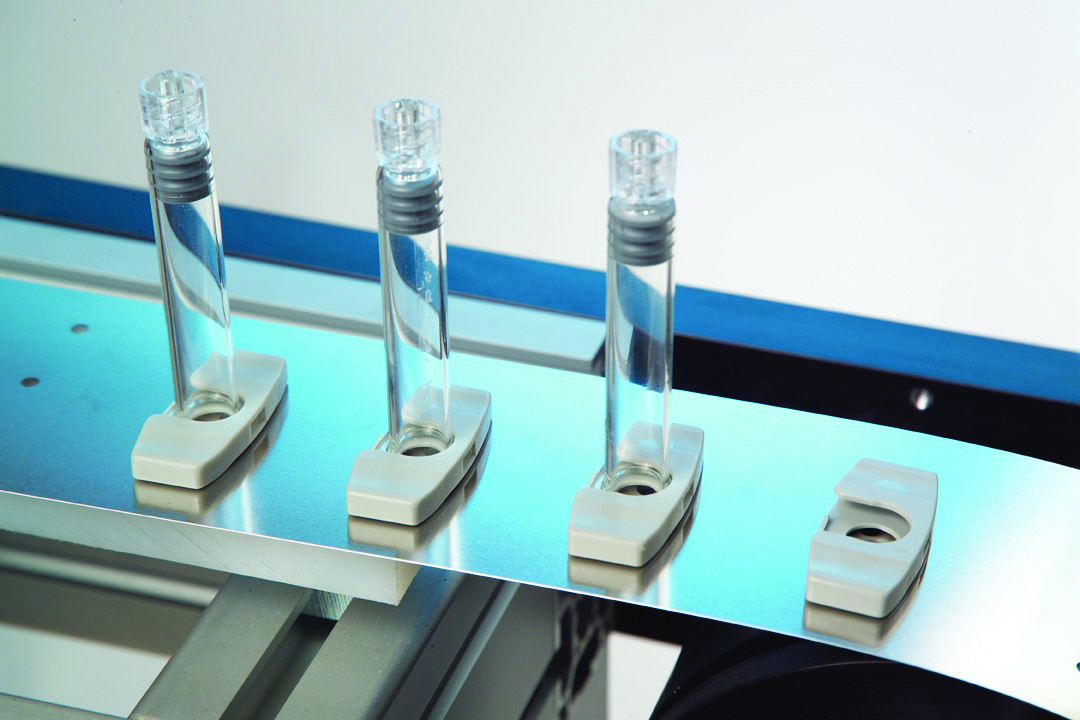
medical syringes being manufacturedIn addition to inherent corrosion resistance, metal belts withstand high- and low-temperature operating environments that rubber, plastic, or fabric belts cannot. The temperature-resistant qualities of metal belts are advantageous in heated applications such as sterilization tunnels for depyrogenation of glass vials or hot-air drying chambers for pre-coated blood filter processing. Similarly, metal belts are well-suited to low-temperature processes, including cryogenic applications, that could cause brittleness or breakage in alternative materials. When combined with CIP sanitization procedures, metal belts can reduce contamination risks while increasing efficiency by reducing required maintenance downtime.

Product Quality Relies On High Accuracy and Repeatability

The pharmaceutical industry relies on the accuracy and repeatability of its machinery and processes to create products that will meet the needs of pharmaceutical producers. Metal belt conveyor systems offer high-precision tolerances that other materials cannot attain. Metal belts are virtually unstretchable and will maintain accuracy throughout the lifetime of the machine. A common barrier to accuracy on belt conveyor systems is micro part slipping. Due to inertia overcoming the belt friction, a part can move out of place, lowering the accuracy of the system. Metal belts allow for the use of part fixtures to create highly precise systems. Metal belt conveyor systems are highly customizable in order to meet production needs and tight tolerances.

Selecting the correct materials is a critical step in designing a conveyor system that will optimize production rates while maintaining safety. By matching the material to the application, OEMs can avoid unnecessary downtime, increase production rates, and ensure the safety of customers and employees alike.


3 Gründe, aus denen Erstausrüster der Arzneimittelbranche Metall-Transportbänder bevorzugen

Der Arzneimittelmarkt unterliegt einem strengen Wettbewerb und verlangt, dass Erstausrüster der Arzneimittelbranche Ausrüstungen herstellen, die Qualität und Sicherheit garantieren, während sie gleichzeitig eine hohe Effizienz und geringe Produktionskosten sichern. Die Kunden fordern Ausrüstungen zur Arzneimittelverarbeitung, die schnell, präzise, einfach zu reinigen und haltbar sind. Metallband-Transportbandsysteme sind ein integrales Werkzeug, um die Vielzahl an Produktionserfordernissen und -zielen von Erstausrüstern der Arzneimittelbranche und deren Kunden zu erfüllen.

Geringeres Risiko einer Verunreinigung dank Edelstahlbändern

Der größte Vorteil eines Metallband-Transportbandsystems gegenüber anderen Materialien wie Gummi oder Kunststoff ist seine Sauberkeit. Die Arzneimittelfertigung, ebenso wie die Lebensmittelbranche, benötigen eine einfach zu reinigende Umgebung. Die starke, undurchdringliche Oberfläche von Edelstahl minimiert das Anhaften von Bakterien und widersteht ebenfalls Kratzern, Sprüngen und anderen Beschädigungen, die mikrobiologische Verunreinigungen beherbergen können. Ausrüstung, die einfach gereinigt und gepflegt werden kann, hilft, die Sicherheit von Kunden und Angestellten zu gewährleisten. Desinfektionsmittel wie Alkohole, Aldehyde, Peressigsäure und Wasserstoffperoxid werden häufig bei Verfahren zur Kontaminationskontrolle eingesetzt und die Eigenschaften von Stahl gestatten eine starke chemische Reinigung, während gleichzeitig seine Integrität gewahrt wird.

Metallbänder widerstehen anspruchsvollen Umweltbedingungen

Eine ähnliche Überlegung für Transportbandmaterialien in der Arzneimittelbranche betrifft die Korrosionsfestigkeit. Metallband-Transportsysteme können dem strengen Desinfektionssystem, das zur Aufrechterhaltung ordnungsgemäßer Reinräume erforderlich ist, widerstehen. Austenitischer Edelstahl der 300er-Reihe zeigt eine überlegene Korrosionsfestigkeit, während er im Vergleich zu anderen Materialien eine exzellente Stärke, Formbarkeit, Verarbeitbarkeit und Duktilität aufweist. Der hohe Gehalt an Chrom, Nickel und Molybdän in diesen Stählen schafft eine schützende Chromoxid-Oberflächenschicht, die dafür sorgt, dass der Stahl beinahe jeder Art von Korrosion widerstehen kann.


Fertigung medizinischer Spritzen
Zusätzlich zur innewohnenden Korrosionsfestigkeit widerstehen Metallbänder Betriebsumgebungen mit hohen und tiefen Temperaturen, was bei Gummi-, Kunststoff- oder Textilbändern nicht der Fall ist. Die temperaturbeständigen Eigenschaften von Metallbändern sind in beheizten Anwendungen wie
Sterilisationstunneln zur Entpyrogenisierung von Reagenzgläsern oder Heißlufttrockenkammern zur Verarbeitung vorbeschichteter Blutfilter von Vorteil. Auf ähnliche Weise sind Metallbänder für Niedertemperatur-Anwendungen einschließlich kryogener Anwendungen geeignet, die bei alternativen Materialien Sprödigkeit oder Brüche verursachen können. In Kombination mit CIP-Sterilisationsverfahren können Metallbänder das Risiko von Verunreinigungen senken, während sie die Effizienz dank verringerter Stillstandszeiten für Wartungszwecke erhöhen.

Produktqualität ist auf hohe Genauigkeit und Wiederholbarkeit angewiesen

Die Arzneimittelbranche verlässt sich auf die Präzision und Wiederholbarkeit ihrer Maschinerie und Prozesse, um Produkte herzustellen, die die Ansprüche der Hersteller von Arzneimitteln erfüllen. Metallband-Transportbandsysteme bieten hohe Präzisionstoleranzen, die andere Materialien nicht erreichen. Metallbänder sind praktisch nicht dehnbar und halten die Präzision während der gesamten Betriebslebensdauer der Maschine aufrecht. Eine übliche Grenze hinsichtlich der Präzision von Transportbandsystemen ist das Abrutschen von Mikroteilen. Aufgrund der Trägheit, die die Bandreibung überwindet, kann ein Teil verrutschen, wodurch die Genauigkeit des Systems verringert wird. Metallbänder ermöglichen die Befestigung von Teilen, um hoch präzise Systeme zu erschaffen. Metallband-Transportsysteme können sehr gut kundenspezifisch angepasst werden, um die Produktionsbedürfnisse und die engen Toleranzen zu erfüllen.

Die Auswahl der richtigen Materialien ist ein kritischer Schritt bei der Entwicklung eines Transportbandsystems, das die Produktionsrate erhöht, während es gleichzeitig die Sicherheit bewahrt. Durch Anpassung des Materials an die Anwendung können Erstausrüster unnötige Stillstandszeiten vermeiden, die Produktionsraten steigern und die Sicherheit von Kunden und Angestellten gleichermaßen gewährleisten.


Trois raisons pour lesquelles les FEO pharmaceutiques préfèrent les tapis convoyeurs métalliques


Le marché pharmaceutique est extrêmement compétitif et demande que les FEO pharmaceutiques produisent des équipements garantissant la qualité et la sécurité tout en maintenant une haute efficacité et de faibles coûts de production. Les clients veulent des équipements de traitement pharmaceutiques qui soient rapides, précis, faciles à nettoyer et durables. Les systèmes de convoyeurs de tapis métalliques sont un outil intégré pour répondre à la variété des besoins et objectifs des FEO pharmaceutiques et de leurs clients.

Diminuez les risques de contamination avec des tapis en acier inoxydable


L’avantage principal d’un système de convoyeur métallique par rapport à d’autres matériaux tels que le caoutchouc ou le plastique est la propreté. La production pharmaceutique, comme le secteur alimentaire, exige un environnement facilement nettoyable. La surface robuste et imperméable de l’acier inoxydable


minimise l’incrustation de bactéries


et résiste aussi aux éraflures, aux dépressions pouvant abriter une contamination microbienne. Un équipement pouvant être facilement nettoyé et entretenu aide à garantir la sécurité, à la fois pour les consommateurs et les employés. Des désinfectants tels que des alcools, des aldéhydes, l’acide peracétique et le péroxyde d’hydrogène


sont fréquemment utilisés pour les procédures de contrôle de la contamination. Les propriétés de l’acier permettent un nettoyage rigoureux par produits chimiques tout en conservant son intégrité.

Les tapis métalliques supportent des conditions environnementales délicates


Un autre point à considérer pour les matériaux des tapis convoyeurs pharmaceutiques est leur résistance à la corrosion. Les systèmes de tapis convoyeurs métalliques sont capables de supporter le régime de nettoyage complet nécessaire à la maintenance d’une chambre blanche correcte.


La série 300 d’aciers inoxydables austénitiques


montre une résistance supérieures à la corrosion tout en conservant une force, une formabilité, une ductilité et capacité de fabrication excellentes en comparaison d’autres matériaux.


Le contenu élevé de chrome, de nickel et de molybdène de ces aciers crée une couche de surface protectrice en oxyde de chrome permettant de résister à pratiquement toute forme de corrosion.

fabrication de seringues médicales
En plus d’une résistance inhérente à la corrosion, les tapis métalliques supportent des environnements d’utilisation sous hautes et basses températures, ce qui n’est pas le cas pour les tapis en caoutchouc, plastique ou tissu. Les qualités de résistance à la température des tapis métalliques sont avantageuses pour des applications dans la chaleur telles que


les tunnels de stérilisation pour la dépyrogénation des tubes en verre


ou


les chambres de séchage par air chaud pour le traitement de filtrage de sang pré-enduits


. Pareillement, les tapis métalliques sont bien adaptés à des processus sous basses températures, notamment les applications cryogéniques pouvant causer l’effritement ou la cassure d’autres matériaux. Lorsqu’on les combine à des procédures de nettoyage NEP, les tapis métalliques peuvent diminuer les risques de contamination tout en augmentant l’efficacité en diminuant les durées d’arrêt nécessaires pour la maintenance.

La qualité des produits repose sur une précision élevée et la répétition


Le secteur pharmaceutique repose sur la précision et la répétition de ses machines et processus pour créer des produits répondant aux besoins des producteurs pharmaceutiques. Les systèmes de tapis convoyeurs métalliques offrent une tolérance élevée de précision qu’aucun autre matériau n’atteint. Les tapis métalliques sont virtuellement impossibles à étirer et ils conservent leur exactitude tout au long du cycle de vie de la machine. Une barrière usuelle à la précision sur les systèmes de tapis convoyeurs est le glissement de micro-pièces. A cause de l’inertie surmontant la friction du tapis, une pièce peut se déplacer, diminuant l’exactitude du système. Les tapis métalliques permettent l’utilisation de pièces créant des systèmes à haute précision.


Les systèmes de tapis convoyeurs métalliques sont extrêmement personnalisables afin de répondre aux besoins de production et aux tolérances étroites.


Le choix des bons matériaux est une étape cruciale de la conception d’un système convoyeur qui optimisera les taux de production tout en conservant la sécurité. En faisant correspondre le matériau à l’application, les FEO peuvent éviter des durées d’immobilisation inutiles, augmenter les taux de production et assurer aussi bien la sécurité des consommateurs que celle des employés.


Metal Conveyor Belt Design for UV Curing and Magnetic Solidification Processing of Semiconductor Substrate

A world-leader in IT hardware and software production recently contacted Belt Technologies for a custom metal belt conveyor solution. They needed a metal conveyor belt to transport aluminum trays of semiconductor substrate through a UV curing and magnetic solidification process.

Semiconductor Substrate Processing Methods Present Unique Design Challenges

The customer would be using a combination of intense UV radiation and a magnetic field to shape and process a semiconductor substrate material. In order to withstand the UV curing and magnetic solidification stages of the semiconductor production process, the conveyor belt would need to be able to withstand high heat and a strong magnetic field.

Stainless steel has a very high tolerance for heat and is typically considered nonmagnetic, but in practice, most stainless steel alloys have low magnetic permeability. Over time, exposure to the strong magnetic field could cause a stainless steel belt to warp. Our engineers were ready to tackle the challenge of providing a metal conveyor belt that would offer long-lasting and accurate product movement without being distorted by exposure to heat or magnetism.

Inconel 718 Provides Low Magnetic Permeability and High Heat Resistance for Optimal Product Quality

The engineering experts at Belt Technologies recommended an endless metal conveyor belt comprised of Inconel 718, a nickel-chromium-based alloy, due to its lower magnetic permeability and high resistance to heat. Like stainless steel, Inconel 718 is clean—it requires no lubrication and generates no particulates. It does not build up static electricity and would provide the perfect surface on which aluminum trays containing the semiconductor substrate could be transported.

Two sets of holes were laser cut into the Inconel belt to assist with the placement of the trays. A set of silicone v-guides were included in the design of the conveyor to provide force tracking of the belt. We also supplied the customer with shaft holders and shafts, enabling them to install the belt on their existing conveyor frame.

The Design Experts at Belt Technologies Provide Customized and Automated Manufacturing Solutions

Our engineers have the experience and knowledge to assist manufacturers with developing custom manufacturing solutions to the most challenging automation obstacles. We thrive on creating conveyor systems that meet the unique needs of our customers and we are happy to provide engineering assistance to help with any modifications or fabricate special components that may be required.

Does your product present a unique manufacturing challenge? Belt Technologies engineers can help. Contact the design experts today and let us help you find the ultimate automation solution!


Metall-Transportband-Design für UV-Härtungs- und magnetische Verfestigungsverfahren bei Halbleitersubstrat

Ein weltweit führendes Unternehmen der IT-Hard- und Software-Entwicklung kontaktierte jüngst Belt Technologies bezüglich einer kundenspezifischen Metall-Transportbandlösung. Das Unternehmen benötigte ein Metall-Transportband zum Transport von Aluminiumschalen mit Halbleitersubstrat durch ein UV-Härtungs- und magnetisches Verfestigungsverfahren.

Die Verarbeitungsmethoden für Halbleitersubstrat stellen einzigartige Design-Herausforderungen dar

Der Kunde würde ein Kombination aus intensiver UV-Strahlung und einem Magnetfeld einsetzen, um Halbleitersubstrat-Material zu formen und zu verarbeiten. Um der UV-Härtung und den Stufen der magnetischen Verfestigung des Halbleiter-Produktionsprozesses zu widerstehen, muss das Transportband großer Hitze und einem starken Magnetfeld standhalten können.

Edelstahl ist sehr tolerant gegenüber Hitze und wird normalerweise als nichtmagnetisch betrachtet. In der Praxis haben allerdings die meisten Edelstahllegierungen ein niedrige magnetische Permeabilität. Im Laufe der Zeit kann die Aussetzung gegenüber einem starken Magnetfeld dazu führen, dass sich das Edelstahlband verzieht. Unsere Techniker konnten der Herausforderung begegnen, indem sie ein Transportband bereitstellten, das eine dauerhafte und präzise Produktbewegung ohne Verzerrung bietet, wenn es Hitze oder Magnetismus ausgesetzt wird.

Inconel 718 bietet eine niedrige magnetische Permeabilität und eine hohe Hitzefestigkeit für optimale Produktqualität

Die Fachtechniker von Belt Technologies empfahlen ein endloses Metall-Transportband, das aus Inconel 718, einer Legierung auf Nickel-Chrom-Basis, besteht, denn es weist eine sehr niedrige magnetische Permeabilität und eine hohe Hitzefestigkeit auf. Wie Edelstahl ist Inconel 718 sauber — es benötigt weder eine Schmierung noch generiert es Feinstaub. Es baut keine statische Elektrizität auf und stellt eine perfekte Oberfläche dar, auf der die Aluminiumschalen, die das Halbleitersubstrat enthalten, befördert werden.

In das Inconel-Band wurden per Laser zwei Sätze von Öffnungen geschnitten, um bei der Positionierung der Schalen zu helfen. Ein Satz aus Silikon-V-Führungen wurde in das Design des Transportbandes eingefügt, um für eine erzwungene Bandführung zu sorgen. Außerdem belieferten wir den Kunden auch mit Lageroberteilen und Wellen, mit denen das Band am vorhandenen Transportbandrahmen installiert werden konnte.

Die Designexperten bei Belt Technologies stellen kundenspezifische und automatisierte Fertigungslösungen bereit

Unsere Techniker verfügen über die Erfahrung und das Wissen, um Herstellern bei der Entwicklung kundenspezifischer Fertigungslösungen bei den schwierigsten Hindernissen im Bereich der Automatisierung zu helfen. Unser Ziel ist die Entwicklung von Transportbandsystemen, die die einzigartigen Bedürfnisse unserer Kunden erfüllen, und wir freuen uns, technische Hilfe bei allen Modifikationen oder bei der Fertigung von speziellen Komponenten, die eventuell benötigt werden, zu liefern.

Stellt Ihr Produkt eine einzigartige Herausforderung für die Fertigung dar? Die Techniker von Belt Technologies können helfen. Kontaktieren Sie unsere Designexperten noch heute und wir helfen Ihnen, die ultimative Automatisierungslösung zu finden!


Conception de tapis convoyeur métallique pour séchage aux UV et traitement de solidification magnétique de substrats semi-conducteurs


Un leader mondial dans la production de matériels et logiciels informatiques a récemment contacté Belt Technologies pour une solution personnalisée de tapis convoyeur métallique. Il leur fallait un tapis convoyeur métallique pour transporter des plateaux en aluminium de substrats semi-conducteurs à travers un processus de séchage par UV et


de solidification magnétique.


Les méthodes de traitement par substrats de semi-conducteurs présentent des défis de conception uniques


Le client utiliserait une combinaison de radiations UV intenses et un champ magnétique pour donner forme et traiter un matériau de substrat de semi-conducteur. Afin de supporter le séchage par UV et les étapes de solidification magnétique du processus de production du semi-conducteur, le tapis convoyeur devrait supporter une chaleur élevée et un champ magnétique puissant.


L’acier inoxydable possède une tolérance très élevée à la chaleur et il généralement considéré comme non magnétique, mais dans la pratique, la plupart des alliages d’acier inoxydable ont une faible perméabilité magnétique. Au fil du temps, l’exposition à un champ magnétique puissant peut provoquer la torsion d’un tapis en acier inoxydable. Nos ingénieurs étaient prêts à relever le défi et fournir un tapis convoyeur métallique qui proposerait un mouvement précis sur le long terme du produit, sans être tordu par l’exposition à la chaleur ou au magnétisme.

L’Inconel 718 procure une faible perméabilité magnétique et une résistance élevée à la chaleur pour une qualité de produit optimale


Les experts en ingénierie de Belt Technologies ont recommandé un tapis convoyeur métallique sans fin comprenant de l’


Inconel 718


, un alliage à base nickel-chrome, à cause de sa faible perméabilité magnétique et de sa résistance élevée à la chaleur. Tout comme l’acier inoxydable, l’Inconel 718 est propre, il ne nécessite aucune lubrification et il ne génère pas de particules. Il n’accumule pas d’électricité statique et fournit une surface parfaite sur laquelle les plateaux en aluminium contenant le substrat semi-conducteur peut être transporté.


Deux ensemble de trous ont été perforés au laser dans le tapis en Inconel pour aider au placement des plateaux. Un ensemble de guides de silicone en V ont été inclus dans le design du tapis afin de procurer une force de traction du tapis. Nous avons aussi fourni au client des axes et des mainteneurs d’axes, lui permettant d’installer le tapis sur leur structure de convoyeur existante.

Les experts en conception de Belt Technologies fournissent des solutions de fabrication personnalisées et automatisées


Nos ingénieurs possèdent l’expérience et les connaissances nécessaires pour aider les fabricants à mettre au point des solutions de fabrication personnalisées adaptées aux obstacles d’automatisation les plus délicats. Nous faisons notre possible pour créer des systèmes convoyeurs répondant aux besoins uniques de nos clients, et nous sommes heureux de fournir une assistance d’ingénierie pour aider au niveau de toute modification ou pour fabriquer les composants spéciaux pouvant être demandés.


Est-ce que votre produit présente un défi de fabrication unique ? Les ingénieurs de Belt Technologies peuvent aider.


Contactez dès aujourd’hui les experts en conception


et laissez-nous vous aider à trouver la solution d’automatisation suprême !


Stainless Steel Drive Tapes for CMM Machinery and Metrology Equipment

A major OEM in the metrology and precision optical instrumentation industry recently approached Belt Technologies seeking drive tapes for its new line of coordinate measuring machines (CMMs).

The company has been incorporating stainless steel drive tapes into their machines for nearly twenty years. The metal drive tapes are used to actuate the CMM inspection cameras on the X-Y plane. Almost ready to launch its new and improved generation of CMMs, the OEM was committed to achieving a design that would exhibit highly precise positional accuracy.

Metrology Equipment Depends on High Accuracy and Precision for Effective Results

CMMs are mechanical systems designed to determine coordinate points on a workpiece and provide precise measurements of components for the purpose of design, testing, profiling, and reverse engineering. CMMs are used to verify the manufacturing processes for extremely complex equipment, including medical devices and aerospace vehicles. The manufacturers using these machines stake their reputations on producing parts and equipment to specification. In order for coordinate measuring machines to be effective, they must have reliable positional capabilities to determine accurate coordinate points on workpiece surfaces.

Drive Tapes by Belt Technologies Achieve Ultimate Positional Accuracy

Metal drive tapes by Belt Technologies are made of the same high-quality materials as our stainless steel conveyor belts. They can be fitted with specialized attachments or perforations as needed. Stainless steel drive tapes are able to resist extreme environments and are highly sanitary. They are used for a variety of applications including:

  • linear drive tapesMetrology equipment
  • Robotics
  • Automated manufacturing equipment
  • Carriage positioning in printing and cutting applications
  • Optical element drives

Over time, motion loss and backlash of timing belts can cause inaccurate positioning and movement. Stainless steel drive tapes are virtually unstretchable and are able to perform with near-zero backlash, making them the ideal choice for metrology applications that require a high level of positional accuracy.

The client was satisfied with the operational accuracy their CMMs were able to attain with their new stainless steel drive tapes. When accuracy is paramount, OEMs trust Belt Technologies to provide custom solutions that will achieve precision results. Would your automated system design benefit from the long-lasting reliability of metal drive tapes? Contact the experts at Belt Technologies today!