Deprecated: ltrim(): Passing null to parameter #1 ($string) of type string is deprecated in /home/beltdev/public_html/wp-includes/formatting.php on line 4496
How a metal belt improved a time-honored tradition
It is believed that tamales originated as early as 8000 to 5000 BC in Mesoamerica. Adopted by Aztec and Mayan civilizations and then Mexican and Guatemalan cultures, tamales are enjoyed for their portability and versatility. Made of masa or dough steamed in a corn husk or banana leaf, tamales can be stuffed with meats, cheeses, fruits, vegetables, chilies, or any combination thereof. While eating them is easy, producing them can be tedious. It is for this reason that tamales are typically mass produced, often around the holidays, to be stored and enjoyed throughout the following year.
When engineering student Alejandra Marroquin had the opportunity to improve the time-consuming process, she seized the opportunity, putting her manufacturing knowledge and mechanical inclinations to use in her Senior Design class at California State University Long Beach.
The Assignment
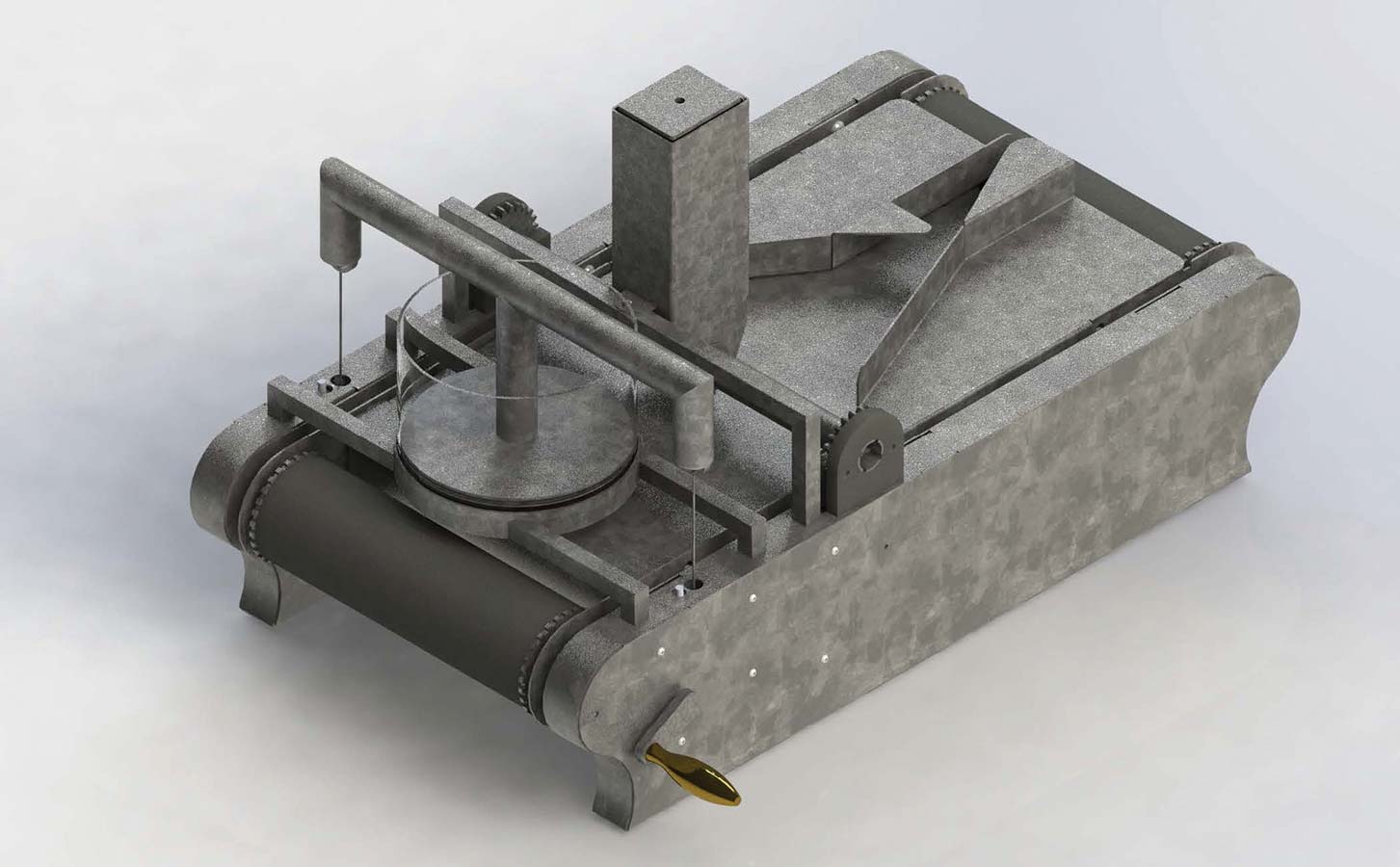
Alejandra’s Senior Design professor placed students into groups, and allowed each to plan, design and produce a working prototype as their final project. Alejandra and her partners quickly settled on the prototype to produce: a hand-crank tamale maker. The idea was to cut down on the amount of time necessary to produce each tamale, and moreover, cut down on the manual stretching and rolling required.
The Plan
Students used computer-aided design software, SolidWorks, to plan and map out the design of their assembly. Taking into consideration the various stages of tamale production—the extrusion of dough or masa, dispersion of filling, folding of the corn husk—they also considered how best to achieve a proper gear ratio and timing system. From the beginning, the students recognized the need for food grade parts including gears, a crank and conveyor belt, all of which they intended to source or fabricate.
The Materials
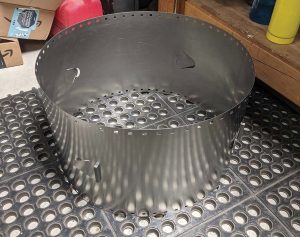
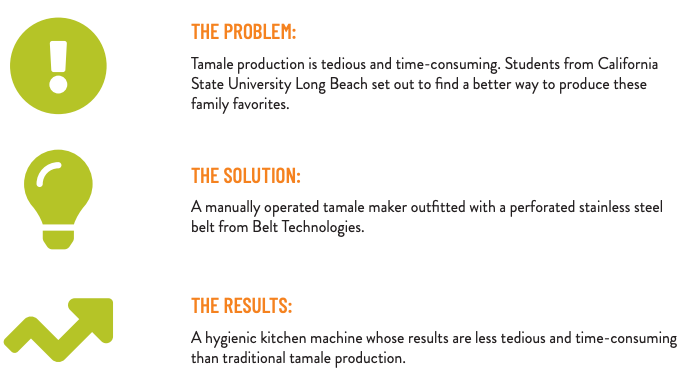
In researching sanitary conveyor belts through an online search, Alejandra learned of and contacted Belt Technologies to discuss her project and to place what she believed would be an order. Recognizing the students’ entrepreneurial spirit and design sense, Belt was happy to deliver a gratis perforated endless belt. Not only did the belt meet the design specs, but it was also a durable and sanitary addition to the newly devised kitchen equipment, meeting safe food handling recommendations of the Food and Drug Administration.
The Results
The prototype developed is a mechanical tamale maker driven by a hand crank. After latching a corn husk into a slot on the stainless steel belt from Belt Technologies, the user must rotate the crank clockwise to engage gears that will move the tamale through each stage of production. This is accomplished smoothly, hygienically and with significantly less effort than one would exert if producing a tamale by hand.
Of the results, Alejandra Marroquin expressed appreciation for Belt Technologies, stating that, “The conveyor is really at the heart of the prototype. We are so grateful to Michael Loomer [Belt Technologies’ Business Development Manager] who not only helped with the part design but also with the fabrication and shipping.”
Michael Loomer was equally appreciative of the opportunity to contribute to the project sharing, “We always are up to a design challenge and although this was a student project, our design intake, consultation and design was not dissimilar from a traditional company order. We’re happy to hear that our product aided in the finished project and wish Alejandra and her team members continued success in the future.”
“The conveyor is really at the heart of the prototype. We are so grateful to Michael Loomer [Belt Technologies’ Business Development Manager] who not only helped with the part design but also with the fabrication and shipping.” — Alejandra Marroquin, California State University Long Beach student
Metal belt systems improve cycle times, reduce costs for automated assembly lines
A key to automation success, in general, is to improve productivity and reduce operating costs, while creating new, innovative products for a defined customer base. This premise is especially true in the medical industry. When a U.S.-based medical manufacturer needed to accomplish this task, they needed to look no further than Belt Technologies who solved not one but two complex automation issues.
It’s in our DNA
Our tagline is “Precision on the Move,” and it’s by design—and found in each of our designs. First called upon to design automation equipment used in the production of revolutionary test systems for DNA analysis technology, our company was immediately put to the test, challenged to improve cycle times and reduce costs.
While the manufacturer’s DNA test procedure was markedly faster than competitive tests, and even faster than the company’s own previous offerings, the process by which the manufacturer produced the test was not. Initially, the company was producing the disposable reaction tube—a key element in the test—by hand, completing a paltry 400 tubes per day. Needless to say, some degree of automation was necessary to create the needed 18 million parts per year.
But increased throughput was only half of the equation: cost savings was the other.
After investigating a variety of options, a metal belt conveyor system was chosen to replace the automation in place, with the belts and pulleys supplied by Belt Technologies. The result? Improved process times and more than that—with the new configuration, four separate products could be run on the same line, increasing profits and making strides in the medical field.
The Nuts and Bolts of it All
Metal belts offer advantages over similar products, as well as belts made of other materials. To begin with, metal belts possess various unique properties that result in superior precision control, longevity, and cost effectiveness. In many cases, they are preferable to other belt types (such as rubber and fiberglass) as metal belts do not stretch like standard timing belts, and variations in surface speed are minimized. Metal belts from Belt Technologies also run without lubrication of any kind, offer unlimited travel lengths, and are available in a variety of alloys. When compared with other power transmission or motion control components (such as linear actuators, lead screws, and chains) metal belts are often preferred, due to their high strength-to-weight ratio, durability, and precise positioning.
After each assembly line was built, drive and idler pulleys, metal belts, and timing screws, which are used to attach the cleats, were integrated into the production process. Running flawlessly since 1999, the company again turned to Belt Technologies in 2020 in light of the COVID-19 pandemic to assist in the production of testing kits.
One of the key benefits of this vertical conveyor system is the flexibility to handle multiple products. The belts were designed to connect with the company’s proprietary tooling through a common interface designed into each tool covering an array of different products, allowing for reduced changeover times. What’s more—the vertical solution, by utilizing both sides of the metal belt, doubled output without increasing operational costs. This was an especially important consideration considering the urgency of brining COVID-19 test kits to market. Furthermore, given the direct public benefit of these test kits, Belt Technologies gave top priority to producing these belts on an expedited basis to meet the company’s substantially increased demand. It’s safe to say that Belt Technologies was “just what the doctor ordered” for this U.S. manufacturer. Does your assembly line need a similar cure?
“We looked at various conveyor products and had a problem with the high mass of the system. The obvious solution was metal belts, which provide low inertia and excellent repeatability. Plus, in the future, we could also extend the line very easily, due to the flexibility of the belts.” —project lead
Stahlbandsysteme verbessern die Taktzeiten und senken die Kosten für automatisierte Montagelinien
Der Schlüssel zum Erfolg der Automatisierung besteht im Allgemeinen darin, die Produktivität zu verbessern und die Betriebskosten zu senken, während gleichzeitig neue, innovative Produkte für einen definierten Kundenstamm geschaffen werden. Diese Prämisse gilt insbesondere für die Pharma-Industrie. Als ein in den USA ansässiger Hersteller von medizinischen Geräten diese Aufgabe erfüllen musste, brauchte er nicht lange suchen. Belt Technologies löste nicht nur eine, sondern gleich zwei komplexe Automatisierungsprobleme mit einer Lösung.
Es liegt in unserer DNA
Unser Motto lautet „Präzision in Bewegung“ und ist natürlicherweise in jedem unserer Konzepte enthalten. Unser Unternehmen wurde direkt auf die Probe gestellt, Automatisierungsgeräte für die Herstellung revolutionärer Testsysteme für die DNA-Analysetechnologie zu entwickeln, um die Zykluszeiten zu verbessern und gleichzeitig die Kosten zu senken.
Obwohl das DNA-Testverfahren des Herstellers deutlich schneller war als bei Wettbewerbstests, war der Herstellungsprozess selbst, sehr zeitaufwendig. Anfänglich produzierte das Unternehmen das Einweg-Reaktionsröhrchen – ein Schlüsselelement des Tests – von Hand und konnte lediglich 400 Röhrchen pro Tag fertigen. Es war offensichtlich, dass ein gewisser Automatisierungsgrad erforderlich war, um die geforderten 18 Millionen Teile pro Jahr herzustellen.
Ein höherer Durchsatz war jedoch nur die halbe Miete: Kosteneinsparungen waren die andere.
Nach Prüfung einer Vielzahl von Optionen wurde ein Metallbandfördersystem mit Bändern und Riemenscheiben von Belt Technologies ausgewählt, um die vorhandene Automatisierung zu ersetzen. Das Ergebnis? Verbesserte Prozesszeiten und mehr – mit der neuen Konfiguration konnten vier separate Produkte auf derselben Linie hergestellt werden, was den Gewinn steigerte und einen großen Fortschritt im medizinischen Bereich darstellt.
Das A und O der Stahlbandtechnologie
Metallbänder bieten Vorteile gegenüber ähnlichen Produkten und Bändern aus anderen Materialien. Zunächst besitzen Metallbänder verschiedene einzigartige Eigenschaften, die zu einer überlegenen Präzisionskontrolle, Langlebigkeit und Kosteneffizienz führen. In vielen Fällen sind sie anderen Riementypen (wie Gummi und Glasfaser) vorzuziehen, da sich Metallriemen nicht wie Standard-Zahnriemen dehnen und Schwankungen der Oberflächengeschwindigkeit minimiert werden.
Metallbänder von Belt Technologies laufen auch ohne jegliche Schmierung, bieten unbegrenzte Verfahrwege und sind in einer Vielzahl von Legierungen erhältlich. Im Vergleich zu anderen Kraftübertragungs- oder Bewegungssteuerungskomponenten (wie Linearantrieben, Gewindespindeln und Ketten) werden Metallbänder aufgrund ihres hohen Festigkeit-zu-Gewicht-Verhältnisses, ihrer Haltbarkeit und ihrer präzisen Positionierung häufig bevorzugt.
Es wurden Metallriemen, Steuerschrauben sowie Antriebs- und Umlenkrollen, mit denen die Stollen befestigt werden, in den Produktionsprozess der Montagelinien integriert. Das in 1996 gegründete Unternehmen betrieb unseren Stahlbandtransport seit 1999 äußerst erfolgreich, wandte sich im Jahr 2020 angesichts der COVID-19-Pandemie jedoch erneut an Belt Technologies, zwecks Unterstützung bei der Herstellung von DNA-Testkits.
Einer der Hauptvorteile dieses vertikalen Fördersystems ist die Flexibilität, mehrere Produkte gleichzeitig zu handhaben. Die Stahlbänder wurden für die Verbindung mit den firmeneigenen Werkzeugen über eine gemeinsame Schnittstelle entwickelt. Diese ist in jedem Werkzeug integriert und deckt eine Reihe verschiedener Produkte ab, wodurch kürzere Umrüstzeiten ermöglicht werden. Darüber hinaus verdoppelte die vertikale Lösung durch die Verwendung beider Seiten des Metallbandes die Leistung, ohne die Betriebskosten zu erhöhen. Dies war angesichts der Dringlichkeit, COVID-19-Testkits auf den Markt zu bringen, ein entscheidener Überlegungsfaktor.
Angesichts des direkten öffentlichen Nutzens dieser Testkits stufte Belt Technologies die schnelle Herstellung dieser Stahlbänder als höchste Priorität ein, um der erheblich gestiegenen Nachfrage des Unternehmens nachzukommen. Somit war Belt Technologies für diesen US-Hersteller „genau das, was der Arzt verordnet hatte“.
Über Belt Technologies
Belt Technologies has been producing custom steel belt conveyor solutions for new and existing conveyor systems for more than five decades. Sophisticated engineering, advanced manufacturing processes and an unlimited variety of configurations and coatings are available to us to customize belts for every application. Steel and indexing belts as well as steel drive belts are superior, high-quality options for automated production and robotic systems.Further information about Belt Technologies and our steel belts / steel belt systems can be found on our website www.belttechnologies.de
Belt Technologies produziert seit mehr als fünf Jahrzehnten kundenspezifische Stahlbandförderlösungen für neue und bestehende Fördersysteme. Anspruchsvolles Ingenieurswissen, fortschrittliche Herstellungsverfahren und eine unbegrenzte Vielfalt an Konfigurationen und Beschichtungen stehen uns zur Verfügung, um Bänder für jede Anwendung individuell zu gestalten. Stahl- und Taktbänder sowie Stahlantriebsbänder sind überlegene, hochwertige Optionen für die automatisierte Produktion und Roboteranlagen.
Weitere Informationen über Belt Technologies und unsere Stahlbänder/ Stahlbandsysteme finden Sie auf unserer Webseite www.belttechnologies.de
Kommentar der Projetkleitung:
“Wir haben uns verschiedene Förderprodukte angesehen und hatten ein Problem mit der hohen Masse des Systems. Die offensichtliche Lösung waren Metallbänder, die eine geringe Trägheit und eine ausgezeichnete Wiederholbarkeit bieten. Außerdem könnten wir in Zukunft die Produktionslinie aufgrund der Flexibilität der Bänder sehr einfach erweitern.“
View
This site is registered on wpml.org as a development site. Switch to a production site key to remove this banner.


 Metal belt systems improve cycle times, reduce costs for automated assembly lines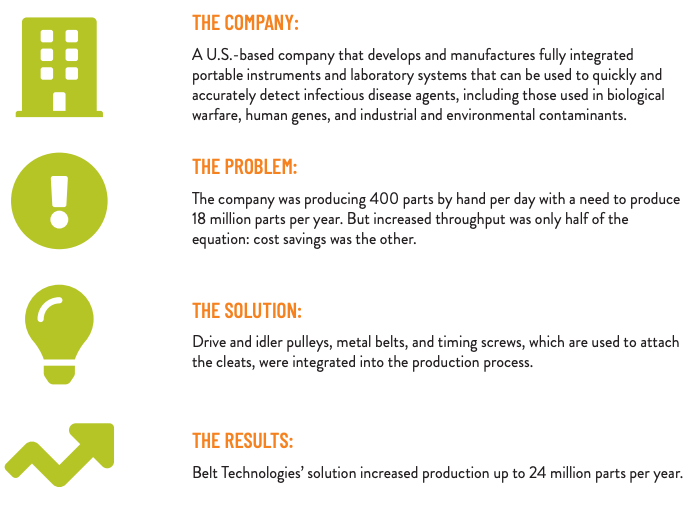
 Stahlbandsysteme verbessern die Taktzeiten und senken die Kosten für automatisierte Montagelinien