Deprecated: ltrim(): Passing null to parameter #1 ($string) of type string is deprecated in /home/beltdev/public_html/wp-includes/formatting.php on line 4496
Lasercomb verfügt über ein jahrzehntelanges Know-how und einzigartiges Expertenwissen. Seit über 45 Jahren entwickeln diese innovative Schneide- und Fräs-Anlagen und verlassen sich hierbei stets auf die PureSteel®-Edelstahlbänder von Belt Technologies zum Antrieb ihrer Schneideinheiten.
Ob Papier, Wellpappe, Carbongewebe, Acryl oder Aluminiumplatten – es gibt kaum ein Material, für das die CMS nicht eine herausragende Lösung hätte. Der Einsatz von PureSteel®-Stahlbändern ermöglicht es der CMS äußerst präzise und zu sehr engen Toleranzen zu arbeiten. PureSteel®-Stahlbänder sind praktisch kaum dehnbar und haben ein sehr hohes Festigkeits-zu-Gewichtsverhältnis, weshalb sich diese hervorragend für die Führung entlang der X- und Y-Achse eignen.
PureSteel®-Stahlbänder ermöglichen einen sehr sanften Lauf der verschiedenen Schneidelemente, was die Zuverlässigkeit der CMS weiter steigert. Die PureStee®l-Stahlbänder laufen darüber hinaus sehr leise und tragen so zu einem besseres Arbeitsklima bei.
Für welche Schneide- und Fräs-Aufgaben Sie die CMS auch immer einsetzen wollen, sie ist ein wahres Multitalent. Die Ingenieure von Lasercomb haben die CMS mit allem ausgestattet, was man für eine gleichbleibende, exzellente Performance bei unterschiedlichen Anwendungsbereichen braucht.
DIE WICHTIGSTEN VORTEILE:
Einfache Bedienung
Hohe Präzision
Wartungsarmer Betrieb durch Einsatz von leistungsfähigen PureSteel®-Stahlbändern
Two of the most important factors in a medical manufacturing space are accuracy and cleanroom capability. When a U.S. based medical equipment manufacturer required a metal belt with a pitch profile that didn’t currently exist, they turned to Belt Technologies. We were able to solve the issue and begin a successful partnership that has lasted more than two decades.
The Customer
Arthur G. Russell Company Inc., based in Bristol, Connecticut, is a preferred turnkey automation system manufacturer with a team that delivers effective results. As the world’s premier provider of custom assembly systems for high-volume disposable medical device production—from syringes to pen needles and pipettes—AGR prides themselves on creating the machines that make it all.
The Search
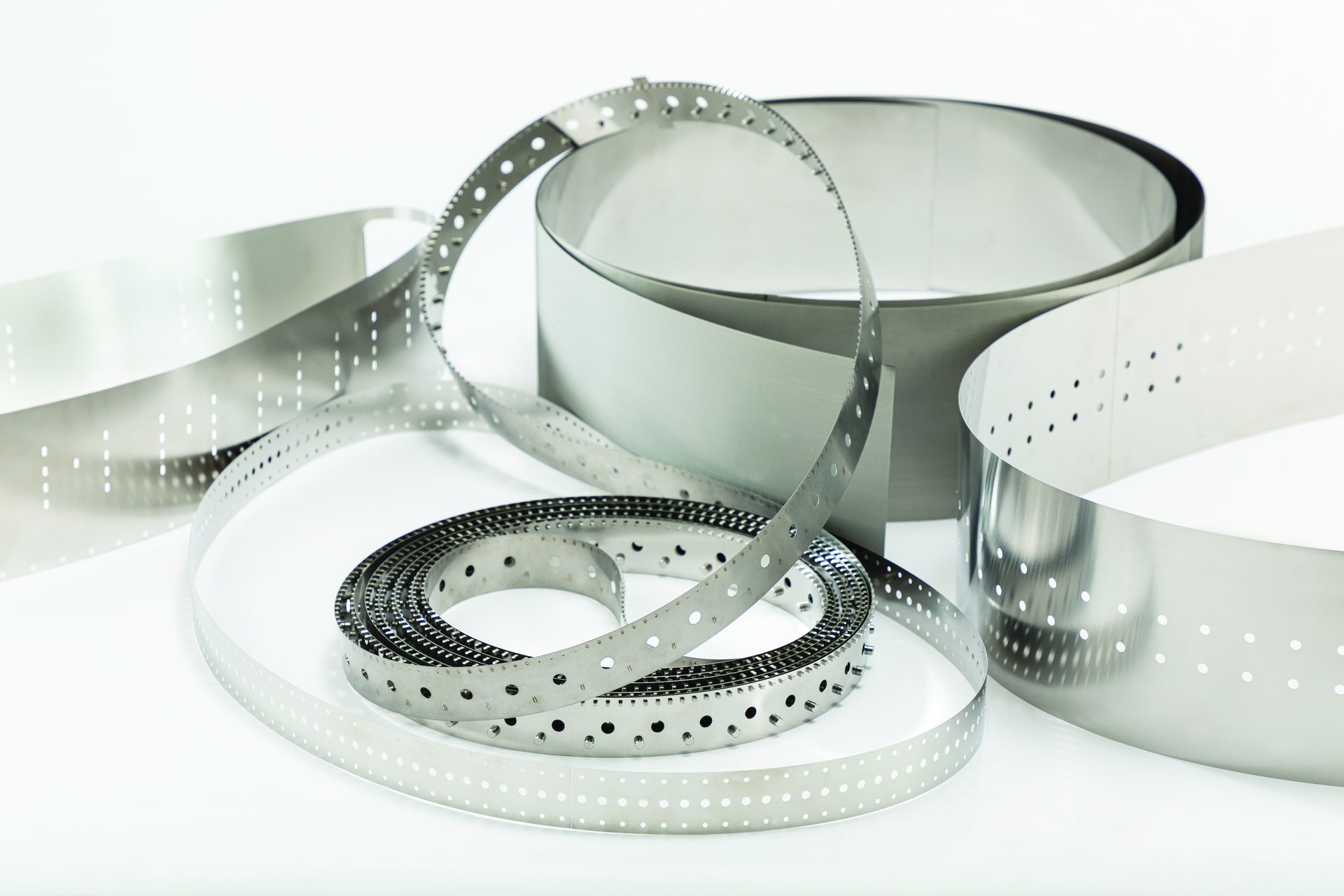
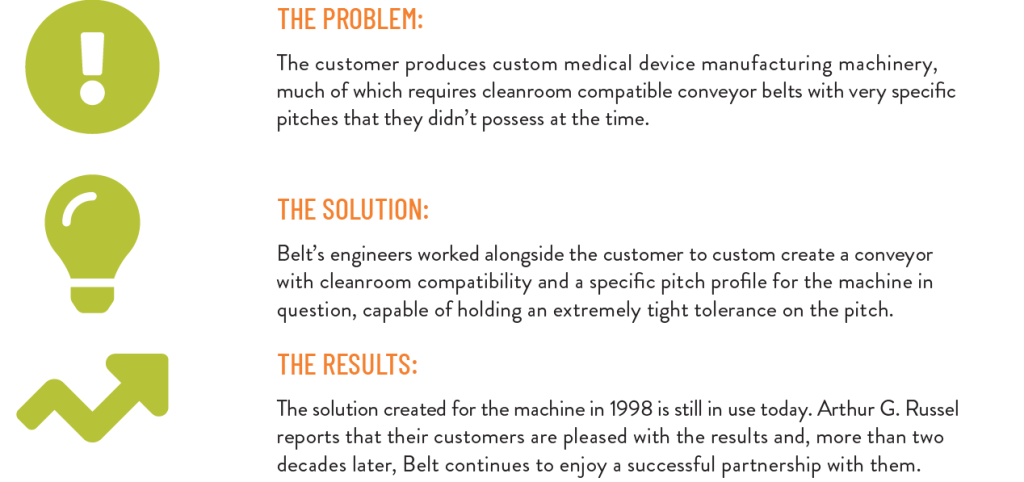
With such a wide array of offerings, the customer is unique in the sense that they build custom automation machinery, much of which requires belts with very specific pitches (the space between individual perforations, timing pins or other such features). In 1998, the client began their search for a company that could provide a conveying solution for a new medical device assembly machine. The machine needed to move small needles for automated assembly of a medical device, so a very precisely designed custom belt was necessary. The required solution needed to excel in a cleanroom environment, while offering repeatability and the personalization of a custom pitch.
During the search for a suitable manufacturer, the customer initially reached out to a different company, but were disappointed to learn they could only offer a belt with a standard pitch. Undeterred, AGR continued their search and struck the right chord with Belt Technologies.
The Decision
Belt Technologies provides several advantages over other manufacturers, including a focus on accuracy, cleanroom compatibility and customization, while offering non-stretch products that do not require lubrication. As customization was the most important aspect for Arthur G. Russell, we were able to work alongside them to create a personalized solution which met their exact specifications. And it’s not just about custom perforation pitches; our customization options also include a broad array of metal alloys, belt width and thickness combinations, perforation patterns, coatings and attachments. Our engineering team was heavily involved in the conversations with AGR’s customer, ensuring they reached a solution that would last.
Repeatable accuracy was also critical to AGR’s design, which meant we had to supply a product capable of holding tight tolerance on the pitch. This was possible due to the fact that metal belts do not exhibit pulsation—enabling precise transmission of the control system’s motion profile. To ensure the most accurate and reliable motion possible, PureSteel® metal belts are manufactured to dimensions with very tight tolerances. This detail-oriented focus allows us to fabricate metal belts with a pitch accuracy of ±0.0005”, which is valuable in designing, indexing, positioning or processing bulk medical devices.
The final stipulation was cleanroom compatibility. Unlike polyurethane, nylon, rubber or fabric belts, metal belts can withstand vacuum conditions and caustic environments. Additionally, metal belts do not require lubrication and do not generate particulates, making them cleanroom compatible and ideal for the customer’s exact specifications.
The Result
The customer reports that the belts last an exceptionally long time. In fact, this solution, which was created for the machine in 1998, is still in use today, and AGR’s customers are pleased with the results.
Following this original order, Belt has held a longstanding, trusted partnership with Arthur G. Russell for more than two decades. They remain the client’s only supplier of precision, thin steel belts, creating a variety of custom belts for new machines over the years.
The Company: A turnkey automation system manufacturer with a team that delivers effective results. As the world’s premier provider of custom assembly systems for high-volume disposable medical device production—from syringes to pen needles to pipettes AGR prides themselves on creating the machines that make it all.
“You can call them [Belt Technologies] and speak to an actual engineer and get design support and advice on their systems. They are dependable, reliable and we like to work with them on custom projects. They are always willing to help us out.”
In post-medieval Europe, laypeople and physicians sought out apothecaries for medicine. Responsible for formulating and selling their own drugs, these professionals were skilled chemists with a penchant for healing. Since then, apothecaries have evolved into the contemporary pharmacist—and while advancements in science have made medicines safer and more effective, today’s pharmacists share the same goals as their historical counterparts. January 12 marks National Pharmacist Day, and to celebrate our modern healers, we are going to highlight how our PureSteel® metal belts and conveyor systems help keep the medical and pharmaceutical manufacturing industries moving.
The Important Role of Pharmacists
While physicians prescribe us with the medicine we need to recover from an illness, it’s not their job to provide us with their suggested remedies. That’s why we head to our neighborhood pharmacy to pick up medicine—but pharmacists do much more than just hand over a drug.
Pharmacists are indeed responsible for providing medicine, but they are also experts in how to correctly store, preserve and take drugs. In the United States, pharmacists must earn a Doctor of Pharmacy degree, and are exceptional resources for people and physicians who are looking for advice on general health topics like diet, how drugs will interact with one another and the side effects of medicine. Pharmacists are crucial in providing information so that people don’t misuse prescription drugs—the manufacturing of which benefits heavily from hygienic metal belts.
Stainless Steel: Sanitary and Safe
In today’s day and age, manufacturing and material handling equipment in the medical and pharmaceutical industries are heavily regulated for safety purposes. Due to this, automated conveyor systems that are used to handle pharmaceutical materials must be completely sanitary, easy to clean and resistant to corrosion. Our PureSteel® metal belts live up to these requirements as they are made from stainless steel, a material known for its smooth and impermeable surface that does not hang on to microbes and bacteria.
Compared to other belt materials such as flat neoprene or HTD, our PureSteel® stainless steel belts do not generate particulate, making them ideal for cleanroom environments. Stainless steel is resistant to corrosion, meaning it can be sanitized by high-pressure steam, high-pressure wash or chemical cleaning. A lack of hidden gaps, recesses and crevices on stainless steel belts also makes them much easier to keep clean than other belt materials. PureSteel® metal belts are also extremely durable, as they are virtually non-stretchable. Combined with a protective chromium oxide surface layer, our belts are the longest-lasting and most hygienic surface for transporting medical equipment and pharmaceutical products.
PureSteel® Helps Make a Pharmacist’s Job Possible
When it comes to adhering to the strict regulations of the pharmaceutical and medical industries, there’s no better product to use in conveyor systems than PureSteel® metal belts. Contact us today to learn more about how we can help you implement our belts in your facility.
This site is registered on wpml.org as a development site. Switch to a production site key to remove this banner.

 In post-medieval Europe, laypeople and physicians