Belt Technologies Logo

A Solution for Battery Production

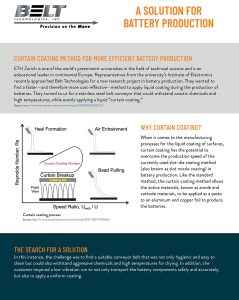
Curtain coating method for more efficient battery production

ETH Zurich is one of the world’s preeminent universities in the field of technical science and is an educational leader in continental Europe. Representatives from the university’s Institute of Electronics recently approached Belt Technologies for a new research project in battery production. They wanted to find a faster—and therefore more cost-effective—method to apply liquid coating during the production of batteries. They turned to us for a stainless steel belt conveyor that could withstand caustic chemicals and high temperatures, while evenly applying a liquid “curtain coating.”

Source: https://www.sciencedirect.com/science/article/pii/S2589004221000237

Source: https://www.sciencedirect.com/science/article/pii/S0377025717305554
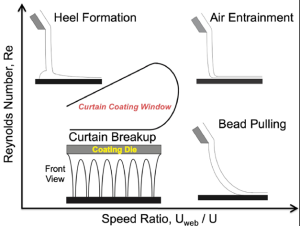
Curtain coating process

Why Curtain Coating?

When it comes to the manufacturing processes for the liquid coating of surfaces, curtain coating has the potential to overcome the production speed of the currently used slot-die coating method (also known as slot nozzle coating) in battery production. Like the standard method, the curtain coating method allows the active materials, known as anode and cathode materials, to be applied as a paste to an aluminum and copper foil to produce the batteries.

The Search for a Solution

In this instance, the challenge was to find a suitable conveyor belt that was not only hygienic and easy to clean but could also withstand aggressive chemicals and high temperatures for drying. In addition, the customer required a low-vibration run to not only transport the battery components safely and accurately, but also to apply a uniform coating.

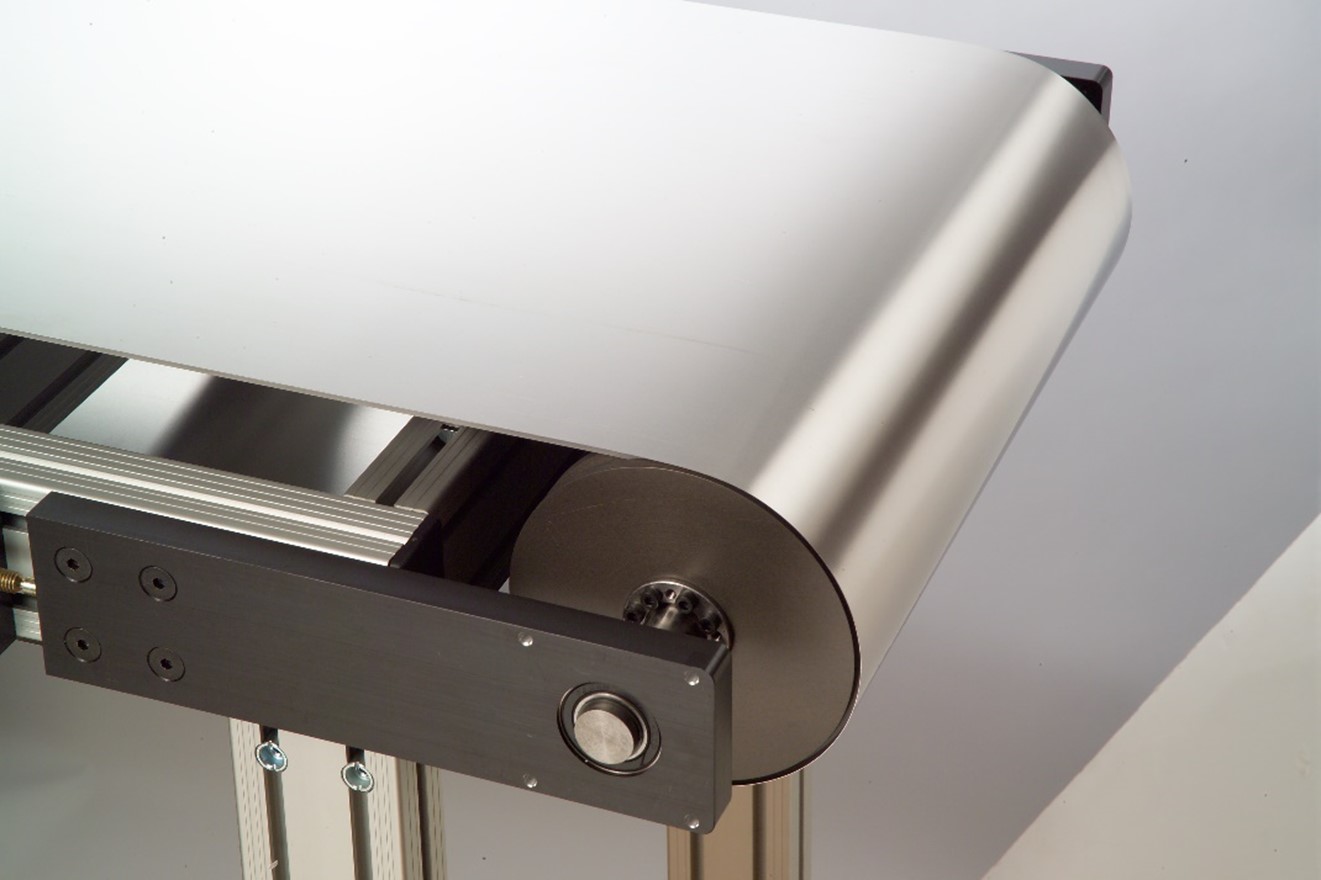
Conventional flat belts were out of the question due to their decomposability through chemicals and particle generation. After a long search, the customer discovered a picture of an endless steel conveyor belt for chocolate production and came looking for us. After an extensive examination of their setup, we determined that a PureSteel® endless metal belt would be the optimal transport solution for the curtain coating system.
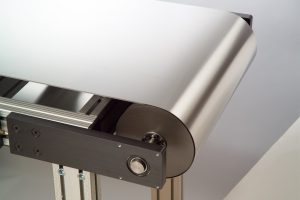
PureSeteel-enldess-metal-belt

Throughout the development project, constant cooperation and communication between Belt Technologies and ETH Zurich led to the delivery of the desired belt, as well as the associated drive and deflection rollers made of aluminum with anodized hardness coating, which were installed in the transport unit designed by ETH Zurich.

Battery quality depends on a precise and error-free coating. Because of this, the fluid-dynamic properties of the paste had to be adapted per the new method. Therefore, the team carried out a CFD simulation of the coating to further investigate the fluid-dynamic behavior of various liquids at the impact point, as well as a laminar distribution over the carrier material. For the experiment, the liquids were applied using a slot-die method and different coating thicknesses were determined based on the different speeds of the belt. The results of the investigation served as a “proof of concept” of the curtain coating method’s ability to enable improved cycle times.

Due to the extremely positive results, it can also be concluded that thanks to the flat and robust steel belt, thinner and less stable current collectors (foils) could be selected for the coating. This would allow for a reduction of “dead weight” in the battery.

Source: https://www.sciencedirect.com/science/article/pii/S2542435121001501

The Search for a Solution

In summary, the project determined that the curtain coating method—in combination with the PureSteel® endless metal belt—can enable chemical, thermal and mechanical stability with simultaneously increased production speed and better cost efficiency for battery production.

If you think you could benefit from one of our PureSteel® products or our engineering expertise, contact our sales engineers today.
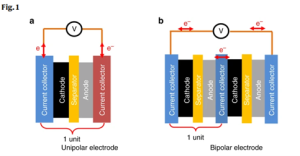
Source: https://www.nature.com/articles/s41467-019-09933-0

Typical battery design
download-cover

Download

Vorhangbeschichtungsmethode für die effizientere Batterieherstellung

Die ETH Zürich, eine der weltweit besten Universitäten im technisch-naturwissenschaftlichen Bereich und führende Universität in Kontinentaleuropa trat an uns für ein neues Forschungsprojekt in der Batterieproduktion heran. Herr Raphael Steffen vom Institut für Elektronik arbeitete eng mit seinen Kollegen zusammen, um eine schnellere und dadurch kosteneffizientere Methode zur Herstellung von Batterien zu finden. Aus den Fertigungsverfahren zur flüssigen Beschichtung von Oberflächen, hat die Vorhangbeschichtung das Potenzial, die Produktionsgeschwindigkeit der momentan verwendeten slot-die coating Methode (Schlitzdüsen-Beschichtung) in der Batterieproduktion zu überwinden.Source: https://www.sciencedirect.com/science/article/pii/S2589004221000237

Curtain coating process
Vorhangbeschichtungsverfahren

Source: https://www.sciencedirect.com/science/article/pii/S0377025717305554

Die Vorhangbeschichtungsmethode erlaubt wie die Standardmethode, das Auftragen der aktiven Materialien, Anoden- und Kathodenmaterial, als Paste auf eine Aluminium- und Kupferfolie um daraus die Batterien zu fertigen.

Die Herausforderung bestand jedoch daraus, ein geeignetes Transportband zu finden, welches nicht nur hygienisch und leicht zu reinigen war, sondern auch aggressiven Chemikalien und hohen Temperaturen zur Trocknung standhalten konnte. Darüber hinaus ist ein schwingungsarmer Lauf von Vorteil, um die Batteriekomponenten sicher und genau zu transportieren und eine gleichmäßige Beschichtung auftragen zu können.

Herkömmliche Flachbandriemen kamen aufgrund Ihrer Zersetzbarkeit durch Chemikalien und Partikelgenerierung nicht in Frage. Nach langer Recherche fand Herr Steffen ein Bild eines Stahlbandes für die Schokoladenherstellung und machte sich auf die Suche nach uns.

Nach ausführlicher Betrachtung des Projektes, befanden wir ein Stahlband als optimale Transportlösung für die Vorhangbeschichtungsanlage.

PureSeteel-enldess-metal-belt

Die gute Zusammenarbeit und stetige Kommunikation zwischen Belt Technologies und der ETH Zürich in diesem Entwicklungsprojekt führte zur Lieferung eines endlosverschweißten Edelstahlbandes und den dazugehörigen Antriebs- und Umlenkrollen aus Aluminium mit eloxierter Härtebeschichtung, welche in die von der ETH entworfene Transporteinheit verbaut wurden.

Die Qualität der Batterie ist dabei abhängig von einer präzisen und fehlerfreien Beschichtung. Dafür müssen die fluiddynamischen Eigenschaften der Paste entsprechend der neuen Methode angepasst werden. Die Aufgabe bestand nun darin eine CFD Simulation der Beschichtung durchzuführen, um damit das fluiddynamische Verhalten verschiedener Flüssigkeiten am Aufprallpunkt sowie eine laminare Verteilung über des Trägermaterials näher zu untersuchen. Experimentell wurden die Flüssigkeiten mittels Slot-Die Verfahren aufgetragen und verschiedene Beschichtungsstärken anhand der unterschiedlichen Geschwindigkeiten des Bandes bestimmt.

Die Ergebnisse der Untersuchung dienen als „proof of concept“ der Vorhangbeschichtungsmethode um verbesserten Taktzeiten zu ermöglichen.

Aufgrund der positiven Resultate lässt sich vermuten, dass Dank des flachen und robusten Stahlbandes, dünnere und weniger stabile Stromabnehmer (Folien) für die Beschichtung ausgewählt werden könnten. Dies würde erlauben „Dead weight“ in der Batterie zu reduzieren. (Source: https://www.sciencedirect.com/science/article/pii/S2542435121001501)

Zusammengefasst ist die Vorhangbeschichtungsmethode in Kombination mit dem Stahlband eine Möglichkeit um die chemische, thermische und mechanische Stabilität bei gleichzeitig erhöhter Produktionsgeschwindigkeit und somit bessere Kosteneffizienz für die Batterieproduktion zu ermöglichen.


Typical battery design

Typischer Aufbau einer Batterie (Source: https://www.nature.com/articles/s41467-019-09933-0)
Könnte das Stahlband die Zukunft der fortschrittlichen Batterieproduktion sein?
Entscheiden Sie selbst und wenden Sie sich noch heute an unsere Vertriebsingenieure.


002937_Belt_ETHZurichCaseStudy_German-1

Download