Belt Technologies Logo

PureSteel belts used for precision measurement technology in the automotive sector

The situation

The automotive industry has to subject itself to ever more stringent regulations when it comes to the safety and quality controls of your vehicles. As a result, improved quality and reliability of the individual components is essential. Reinforced controls and the finest measuring technology are used to put every single part through its paces before it is approved for the construction of a vehicle.

Our customer

MDS Maschinen- und Werkzeugbau GmbH & Co. KG has been a system supplier for automated connection technology for over 50 years. MDS offers holistic solutions from a single source and is known for the production of high-quality fasteners.

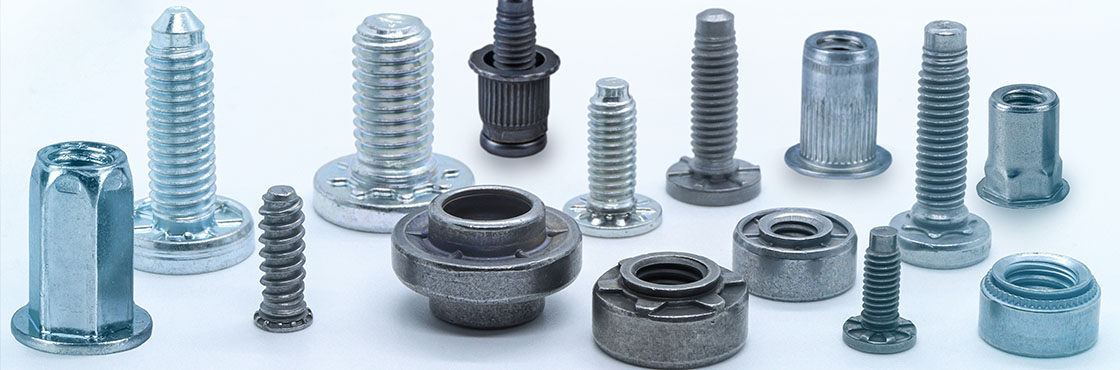
The various fasteners such as press-in or blind rivet nuts, spacers and various bolts are subjected to rigorous quality testing. All connecting elements are subjected to an automated 100% test with regard to optically measurable dimensions before they are sent to the respective customer. The fasteners are measured by a camera system down to the 0.1 µm range and automatically sorted according to OK and NOK parts.

The challenge

The current measuring system could not prevent the belt from running off to the side, which made it necessary to constantly monitor the position of the belt and correct it manually on a regular basis. In addition, there was increased wear on the belts as a result of additional mechanical loads on the drive pulleys.

The challenge was to reduce the wear on the belts and to prevent the belts from running out in order to reduce the pseudo-waste proportion of the measurements. Since all pseudo-reject parts are fed back into the system in order to measure them again, this would reduce process times on the one hand and offer a financial advantage through fewer NOK parts on the other.

The solution

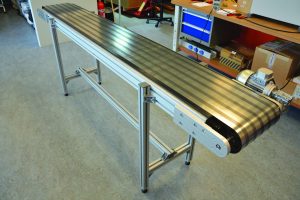
In cooperation with MDS, the measuring system was put through its paces. Here it was found that due to the vertical alignment of the tape and non-ideal roll holders, lateral movement led to tearing of the hole pattern, since the timing elements hit the edge of the hole. However, timing was not necessary for the measured parts. The timing elements were therefore removed and a bare belt used. In order to improve the tracking of the belt and to guide the belt centrally, not only have the reel holders been optimized in order to be able to make the finest adjustments to the angle of the axle, but a narrow silicone coating has also been applied to the middle of the pulleys. This centres the steel belt and does not further increase its bending stress compared to a crowned pulley.

Additionally, we offered laser cutting of the steel belt to halve the tolerance for edge straightness. This will also prevent the nuts from being raised and lowered, which are transported with high precision on the belt edge past the sensitive camera technology.

The conclusion

The service life of the belt has been increased many times over, while at the same time the process times for camera inspection of the fasteners have been significantly reduced. The maintenance effort of the test system was also significantly reduced by the optimizations. The delivery of our PureSteel belts with precise laser cutting is still pending. What is certain, however, is that in cooperation with us, clear advantages have been made possible and that one would like to build on this success.

Please do not hesitate to contact one of our sales engineers today if we can help you with the use of a steel belt in your application. Find out more about our steel belt technology at belttechnologies.com.
Stahlbänder im Einsatz für Präzisionsmesstechnik im Automobilbereich

[et_pb_section fb_built=”1″ _builder_version=”4.21.0″ _module_preset=”default” global_colors_info=”{}”][et_pb_row _builder_version=”4.21.0″ _module_preset=”default” global_colors_info=”{}”][et_pb_column type=”4_4″ _builder_version=”4.21.0″ _module_preset=”default” global_colors_info=”{}”][et_pb_blurb content_max_width=”100%” admin_label=”the situation” _builder_version=”4.21.0″ _module_preset=”default” global_colors_info=”{}”]

Situation

Die Automobilbranche muss sich immer wieder strengeren Auflagen unterwerfen, was die Sicherheit und Qualitätskontrollen Ihrer Fahrzeuge betrifft. Dies hat zur Folge, dass eine verbesserte Qualität und Zuverlässigkeit der einzelnen Komponenten unabdingbar ist. Verstärkte Kontrollen und feinste Messtechnik werden dazu eingesetzt, um jedes einzelne Teil auf Herz und Nieren zu prüfen, bevor dieses für den Bau eines Fahrzeuges zugelassen wird.

Unser Kunde

MDS Maschinen- und Werkzeugbau GmbH & Co. KG ist seit über 50 Jahren Systemlieferant für automatisierte Verbindungstechnik. MDS bietet ganzheitliche Lösungen aus einer Hand und ist für die Herstellung von hochqualitativen Verbindungselementen bekannt.

Die verschiedenen Verbindungselemente wie beispielweise Einpress- oder Blindnietmuttern, Abstandshalter und verschiedene Bolzen werden einer rigorosen Qualitätsprüfung unterzogen. Alle Verbindungselemente werden, bevor sie an die jeweiligen Kunden gesendet werden, einer automatisierten 100% Prüfung bezüglich der optisch messbaren Maße unterzogen. Die Verbindungselemente werden von einem Kamerasystem bis in den 0,1 µm Bereich vermessen und automatisiert nach iO- und niO-Teilen sortiert.

[/et_pb_blurb][et_pb_image src="https://belt.marketmentorsdev.com/wp-content/uploads/2023/07/mds-autoriv-fasteners-automation-verbindungselemente-einpresselement-einpressmutter-einpressbolzen-blindnietelemente-blindnietmutter_0.jpg" alt="mds-autoriv-fasteners-automation-verbindungselemente-einpresselement-einpressmutter-einpressbolzen-blindnietelemente-blindnietmutter_0" title_text="mds-autoriv-fasteners-automation-verbindungselemente-einpresselement-einpressmutter-einpressbolzen-blindnietelemente-blindnietmutter_0" _builder_version="4.21.0" _module_preset="default" global_colors_info="{}"][/et_pb_image][et_pb_blurb content_max_width="100%" admin_label="challenge" _builder_version="4.21.0" _module_preset="default" global_colors_info="{}"]

Herausforderung

Das momentane Messsystem konnte ein Verlaufen des Bandes nicht verhindern, wodurch es notwendig war, die Lage des Bandes permanent zu überwachen und regelmäßig manuell zu korrigieren. Darüber hinaus gab es durch das Verlaufen einen erhöhten Verschleiß der Bänder durch zusätzliche mechanische Belastungen an den Antriebsscheiben.

Die Herausforderung bestand darin, den Verschleiß der Bänder zu verringern und das Verlaufen der Bänder zu verhindern, um somit den Pseudo-Ausschussanteil der Messungen zu reduzieren. Da alle Pseudo-Ausschussteile wieder in das System eingespeist werden, um diese erneut zu vermessen, würde dies zum einen die Prozesszeiten verkürzen und zum anderen einen finanziellen Vorteil durch weniger Fehlteile bieten.

Lösung

In Zusammenarbeit mit MDS wurde die Prüfanlage auf Herz und Nieren untersucht. Hierbei stellte man fest, dass durch die vertikale Ausrichtung des Bandes und nicht ideale Rollenhalter, ein seitliches Verlaufen zum Einreißen des Lochmusters führte, da die Taktelemente auf die Lochkante trafen. Eine Taktung war jedoch gar nicht notwendig für die Messteile. Die Taktelemente wurden daher entfernt und ein blankes Band eingesetzt. Um den Bandlauf zu verbessern und das Band mittig zu führen, wurden nicht nur die Rollenhalter optimiert, um feinste Anpassungen des Winkels der Achse vornehmen zu können, sondern zusätzlich eine schmale Silikonbeschichtung mittig auf den Rollen angebracht. Diese zentriert das Stahlband und erhöht im Vergleich zu einer gekrönten Rolle dessen Biegebeanspruchung nicht weiter.

Zusätzlich bieten wir einen Laserzuschnitt des Bandes an, um die Toleranz der Kantengeradheit zu halbieren. Dies wird zusätzlich ein Anheben und Absenken der Muttern verhindern, welche hochpräzise auf der Bandkante durch die sensible Kameratechnik befördert werden.

[/et_pb_blurb][et_pb_image src="https://belt.marketmentorsdev.com/wp-content/uploads/2023/07/BeltApplication.jpg" alt="BeltApplication" title_text="BeltApplication" _builder_version="4.21.0" _module_preset="default" global_colors_info="{}"][/et_pb_image][et_pb_blurb content_max_width="100%" admin_label="the conclusion" _builder_version="4.21.0" _module_preset="default" global_colors_info="{}"]

Resultate

Die Standzeit des Bandes wurde um ein vielfaches erhöht, während gleichzeitig die Prozesszeiten der Kameraprüfung der Verbindungselemente deutlich verkürzt wurden. Der Wartungsaufwand der Prüfanlage konnte durch die Optimierungen ebenfalls deutlich reduziert werden. Die Lieferung unserer Bänder mit präzisem Laserzuschnitt steht noch aus. Fest steht jedoch, dass in Zusammenarbeit mit uns deutliche Vorteile ermöglicht wurden und man an diesen Erfolg anknüpfen möchte.

Gerne dürfen Sie sich noch heute an einen unserer Vertriebsingenieure wenden, wenn wir Ihnen beim Einsatz eines Stahlbandes in Ihrer Anwendung behilflich sein können. Erfahren Sie mehr über unsere Stahlbandtechnologie auf belttechnologies.de.

[/et_pb_blurb][et_pb_blurb content_max_width=”100%” admin_label=”download” _builder_version=”4.21.0″ _module_preset=”default” hover_enabled=”0″ global_colors_info=”{}” sticky_enabled=”0″]

004436_Belt_SatelliteCells_CaseStudy

Download

[/et_pb_blurb][/et_pb_column][/et_pb_row][/et_pb_section]

Belt Technologies gives an assist to a high school robotics team

Metal drive tape donated to Lansdale Catholic High School helped the team outmaneuver its competition

Robot-After-Competition

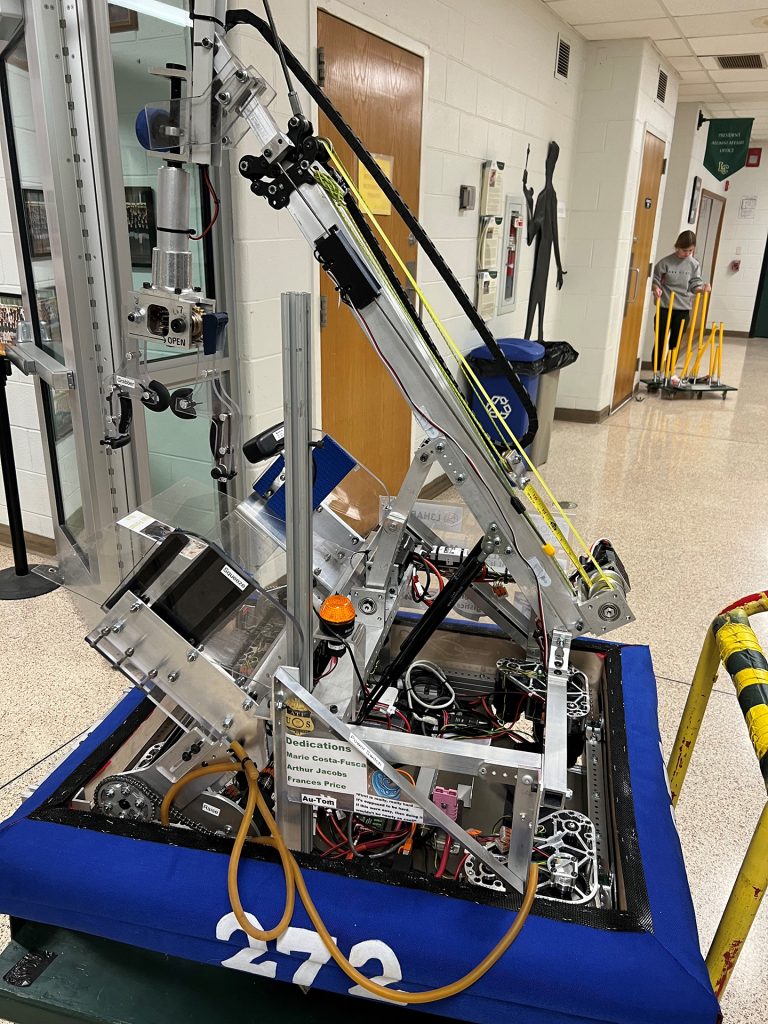
When the students on the robotics team at Lansdale Catholic High School in Pennsylvania needed a metal belt to perfect their robot for competition, they turned to Belt Technologies, Inc. Not only did the donated drive tape perform beyond expectations, but it also helped the team rank first out of 29.

“Our team recently competed in its second competition with a robot featuring the donated drive tape, and both the team and robot performed extremely well,” said John Cross, president and CTO of ASI Drives, a corporate sponsor of Lansdale’s team. “The team ended up with the top-ranked robot out of 29 other teams present, beating robots that had previously won at other competitions. We also won the ‘Engineering Inspiration’ award given to the team that inspired, helped and demonstrated strong engineering competence throughout the season.”

Scott MacDougal, senior sales engineer at Belt Technologies, said, “We were excited for the opportunity to support these students and are so proud of their accomplishments. Growing and encouraging interest in STEM education is important to us. These students and others like them are the leaders of tomorrow.”

Belt’s PureSteel® metal drive tapes are made from the same high-quality stainless steel used in its endless metal belts.  Unlike metal conveyor belts, drive tapes are not endless; they are open-ended with anchor attachments at each end. They are frequently used in design applications that require accurate and reliable motion profiles, such as XY plotting assemblies for robotic arms and equipment. Stainless steel drive tapes are non-stretchable and offer a high strength to weight ratio and accurate and reliable motion.

“This is the best performance the team has had in 26 years of competing,” said Cross. “All the students are very grateful for the donation and support from the folks at Belt Technologies.”

Robot Demos:

Robot Demos

Robot vs Other Robots:

Robot vs. Other Robots

Belt Technologies Creates Out-Of-This-World Solar Panel Solution

PureSteel® vacuum conveyors provide an efficient and accurate solution for satellite solar panel production.

In recent years, the production of solar panels has expanded significantly as the world adapts to an increased need for 21st-century infrastructure technology. While many of these solar cells are used in arrays around the globe as a renewable energy resource—some of those created on our PureSteel® conveyors and belts are serving an out-of-this-world purpose. When a customer required a faster method of assembly for panels in a satellite array, they turned to Belt Technologies for a solution.

The Problem

The customer is an American manufacturer that operates a satellite communications service and provides internet access to a rapidly expanding global subscriber base. To create the necessary panels for all these satellites, the customer incorporated a production line consisting of small stringer conveyors to assemble the cells–each of which use several of our stainless steel belts—and multiple six-axis robots to lift them, turn them and place them in a central area for electrical testing. This last step, which was originally completed by hand, proved to be a bottleneck for the overall operation.

The Solution

The customer reached out to our team for a conveyor that could accurately move cells into place and maintain positioning for electrical testing, before ushering them down the line. They also required a quick turnaround for delivery. The process began when the customer provided Belt with their required specifications for acceleration, speed, cycle-time and duty-cycle.

After an exchange of ideas, our team first created a vacuum conveyor with a perforated belt which helped to maintain the position of the cells during the test. Although the initial belt and vacuum system met all of the customer’s design specifications, it was not achieving their desired performance results. Accordingly, we proceeded to rework the original design, ultimately replacing the vacuum system with one that used a belt with an applied friction coating. This conveyor system proved to be even more successful in achieving the cell position, because in addition to accurately positioning the cells, it also electrically isolates them from the belt for testing.

The Result

Our experienced engineers collaborated with the customer to provide a solution that was easy to install and maintain while surpassing production goals. So far, we have provided three conveyor systems, with plans to provide at least two more.

This customer, like many others, benefitted from our custom, perforated PureSteel® belts that operate in tandem with our vacuum systems to deliver smooth and precise movements. Due to the inherent benefits of stainless steel, the belts won’t stretch over time and can maintain an accurate index for years to come. The success of the project has opened up the opportunity for future projects and partnerships the customer.

company

The Company: An American manufacturer that operates a satellite communications service providing internet access to a rapidly expanding global subscriber base.

problem

The Problem: After experiencing slower-than-desirable production, the customer asked Belt Technologies for a conveyor that could accurately move solar cells into place and maintain positioning for electrical testing
solution
The Solution: Belt Technologies supplied a vacuum conveyor and perforated stainless steel belt with an applied friction coating to accurately position the cells and electrically isolate them from the belt during testing.
results
The Results: Belt has provided the customer with three conveyor systems, which made the production process more efficient. The success has led to the opportunity for an ongoing partnership.

Belt Technologies Lends a Hand to Revolutionary Surgical Robotic Arms

Multilayered PureSteel® drive tapes prove essential in groundbreaking robotic surgery technology.

Robot-assisted surgery is transforming the medical field, allowing doctors to regularly perform complex procedures with unparalleled precision and control. In addition to being more accurate and less invasive, this technology allows top doctors in major metropolitan areas to perform surgeries at a distance, providing top-quality care to patients outside these areas who wouldn’t normally have access. Presently, there is one major hurdle toward widespread integration: cost. One company in India is trying to change that by developing new, technologically advanced yet cost-effective surgical systems that would benefit patients around the world. Discover why they chose Belt Technologies as a partner for this undertaking.

Product-Render-3

The Customer

A major medical equipment manufacturer based in northern India is revolutionizing robotic surgery with a solution that is affordable and accessible to underserved markets. The company has been operating in the field of medical robotic technology for the past decade with the ultimate goal of improving the quality of medical services for patients all over the world. Their surgical robotic system is improving access to surgery and health care for many who might not be able to receive it.

Product-Render-1

The Challenge

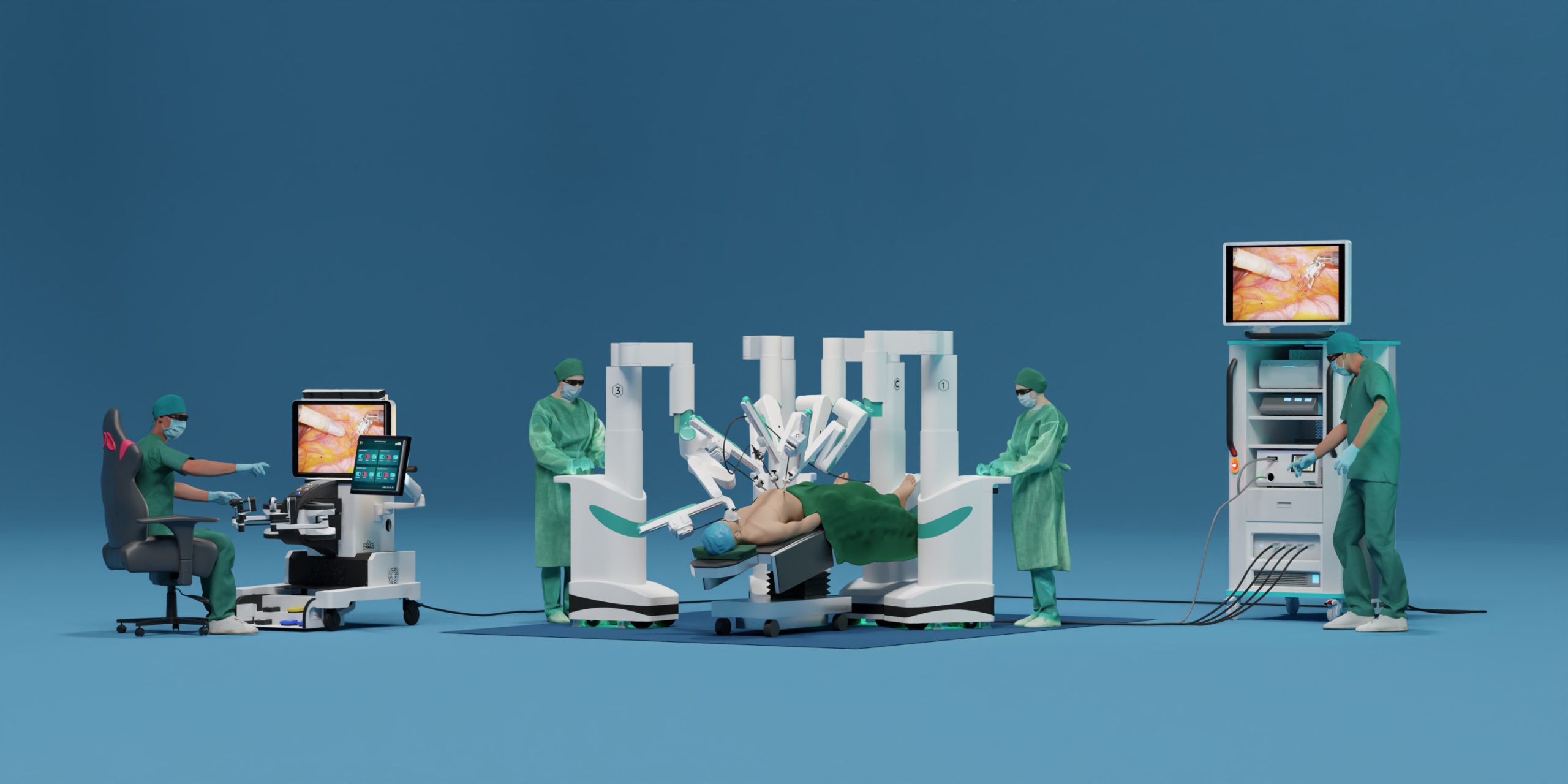
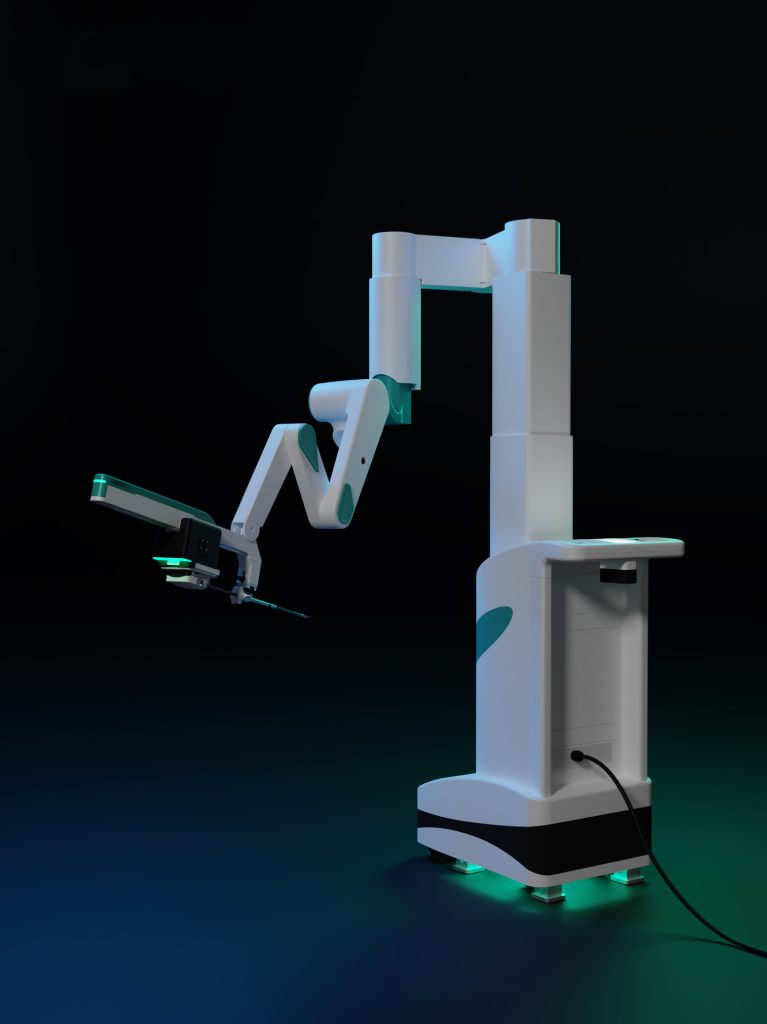
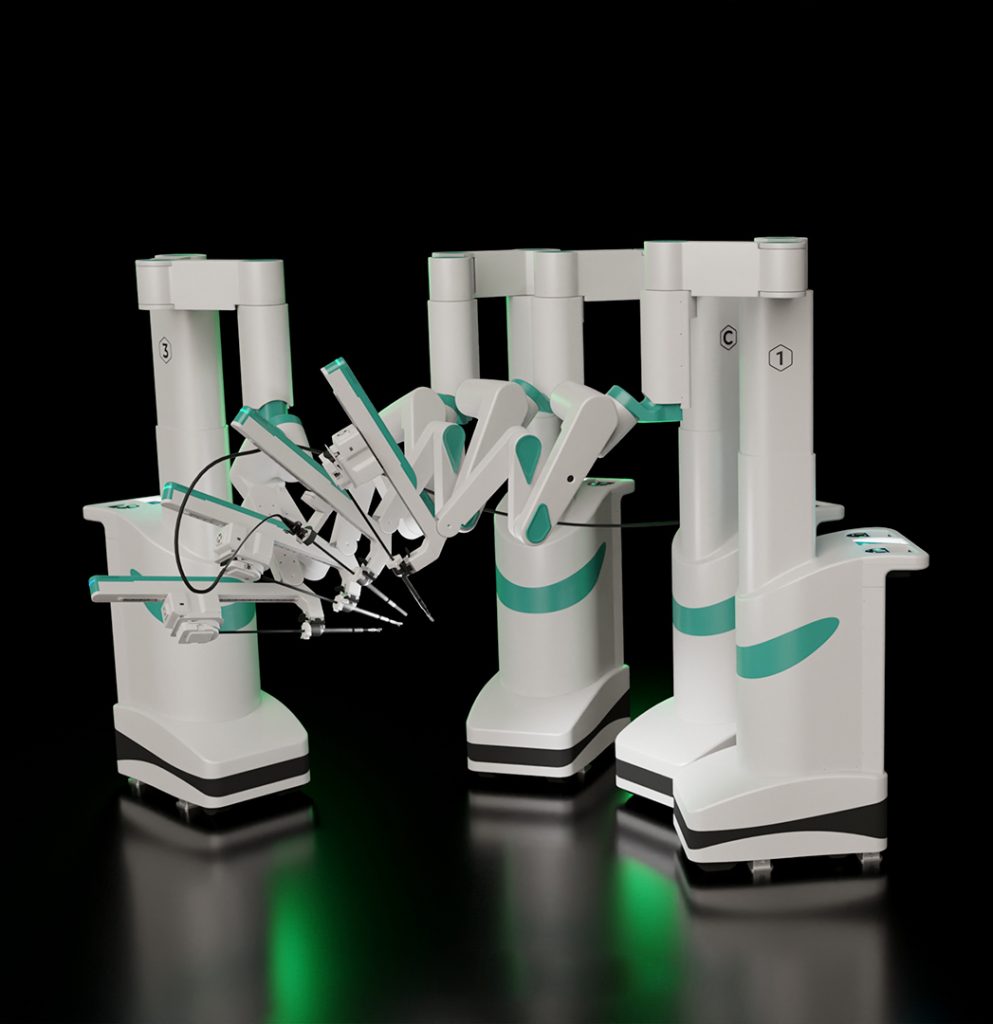
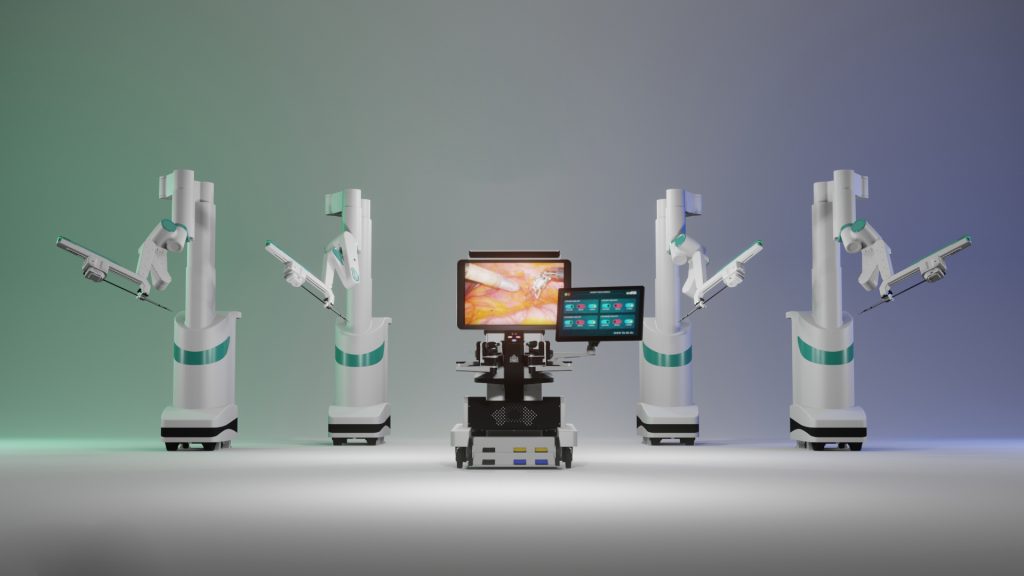
The system features a modular design of up to five robotic arms on individual motorized carts, allowing them to be placed anywhere throughout an operating room. Depending on the procedure, medical professionals use between three and five of the arms through a central Surgeon Command Center that includes a high-definition monitor and ergonomically designed hand controls.

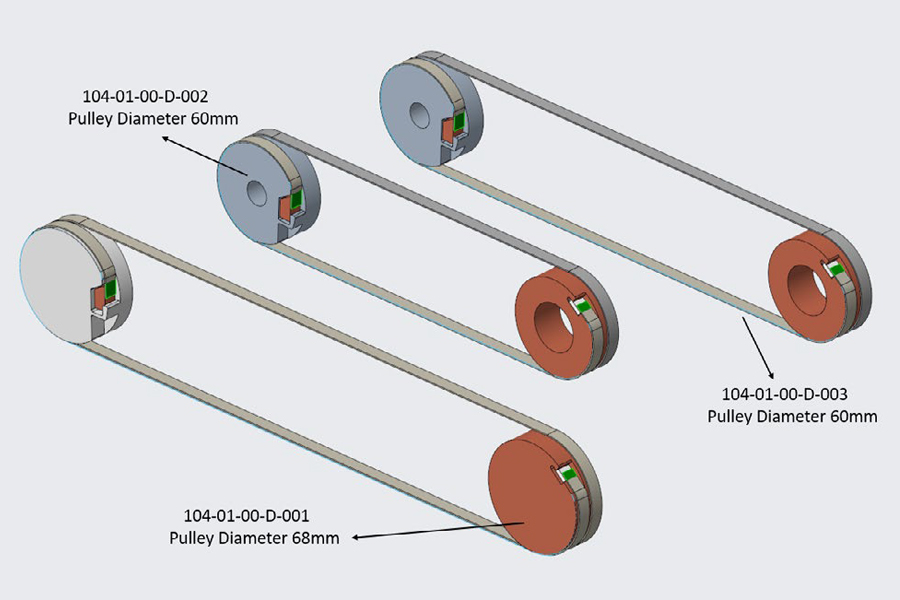
Each of the system’s five arms contains three joints. The individual joints are made up of two pulleys and two separate drive tapes for a total of up to 30 belts per system. These robotic arms must operate in conjunction with one another in a very confined space while holding small instruments. For this reason, the pulleys included in the system have to be as small as possible. Additionally, due to the delicate nature of surgery, the motion of these robots has to be entirely jerk-free with zero backlash.

The Solution

The biggest constraint our engineers encountered for this system was the need to decrease the size of the pulleys while maintaining the relative strength of a thicker metal drive tape. As a general rule of thumb, the thicker the belt, the larger the pulley needs to be to ease the bending stresses on the belt. Our solution was to incorporate two PureSteel® drive tapes, each with six layers of 0.127 mm thick stainless steel, stacked on top of one another and precision welded to form one uniform body. This multilayered belt configuration allows for a reduced pulley diameter while also allowing the system to carry heavy working loads due to the design’s increased cross-sectional area.

Product-Render-2

The pulleys are designed to only rotate 180 degrees, which means there is zero risk for quick, jerky motions. The two drive tapes work in tandem, with one propelling forward and the other driving the reverse motion. Given the inelasticity of steel, this design handles rapid acceleration and reversing without inducing any backlash.

The Results

104-01-00-d-002-pulley

The customer is now producing these systems at a fraction of their competitors’ cost.

In January 2023, the first thoracic surgery was performed with one of the systems. The procedure was a great success, and it’s not the only one; that first system has already completed more than a hundred successful surgeries since it was clinically implemented in December 2022.

Due in large part to these recent successes, our partnership has spurred mutual growth for both the customer and Belt Technologies. The company currently has orders for three dozen more robots over the next year, with planned yearly production increases for the foreseeable future.

The Company: A major medical equipment manufacturer based in northern India is revolutionizing robotic surgery with a solution that is affordable and accessible to underserved markets.

The Challenge: The customer needed to incorporate belts and pulleys in their system’s robotic arms. Due to the highly delicate nature of the surgery, the solution needed to be small and strong with zero risk of backlash.

The Solution: Our team incorporated a multilayered PureSteel® drive tape solution with six individual layers stacked on top of one another and precision welded to form one uniform body, reducing pulley diameter while increasing strength.

The Results: The customer’s system has facilitated more than a hundred successful surgeries and they have orders for more than three dozen robots, with planned production increases.

Download

Belt Technologies Rolls Out Critical Solution for Vaccine Processing and Packaging Conveyor

PureSteel® belts provide a hygienic and durable solution for cleanroom environments and pharmaceutical production.

 At the height of the COVID-19 pandemic, medical professionals and pharmaceutical manufacturers had to quickly distribute protective items such as masks and testing kits to delay the spread of the virus. The need for this rapid response was compounded upon the development of a vaccine, as massive quantities of liquid had to be quickly packaged and distributed across the globe. In 2021, a UK-based conveyor manufacturer was tasked with creating a turnkey, vaccine-packaging system that would facilitate a 17-fold increase in vaccine production—they relied on Belt Technologies to provide a solution that could be supplied with a short turnaround.

ISOMA Video

The Customer

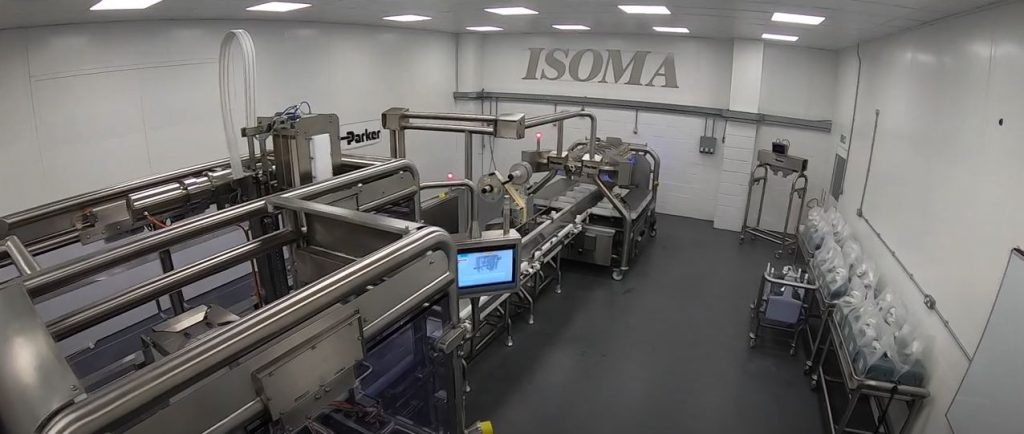
Located in Derbyshire, England, ISOMA was established in 1983 with an emphasis in the fields of process engineering and stainless steel fabrication for the dairy and brewing industries. Gradually, the company evolved into conveyor production for a variety of businesses, specializing in everything from stand-alone conveyors to turnkey systems that encompassed the entire product-handling process.

The Challenge

In mid-2021, ISOMA was chosen to create a machine that could expedite the packaging process of a newly developed COVID-19 vaccine. Due to the nature of the task, the machine needed to be capable of operating within a temperature-controlled, cleanroom environment.

This specialized application environment led ISOMA to search for a unique belting solution to do the job. They initially encountered an issue with the design, as the plastic-tooth belts that they regularly incorporated into other operations were not suitable for two reasons: unsatisfactory hygiene and strength. As steel belts do not generate particulate and can resist corrosive cleaning, they determined our PureSteel® belts would address these issues and reached out to us for help.

ISOMA Video

The Solution

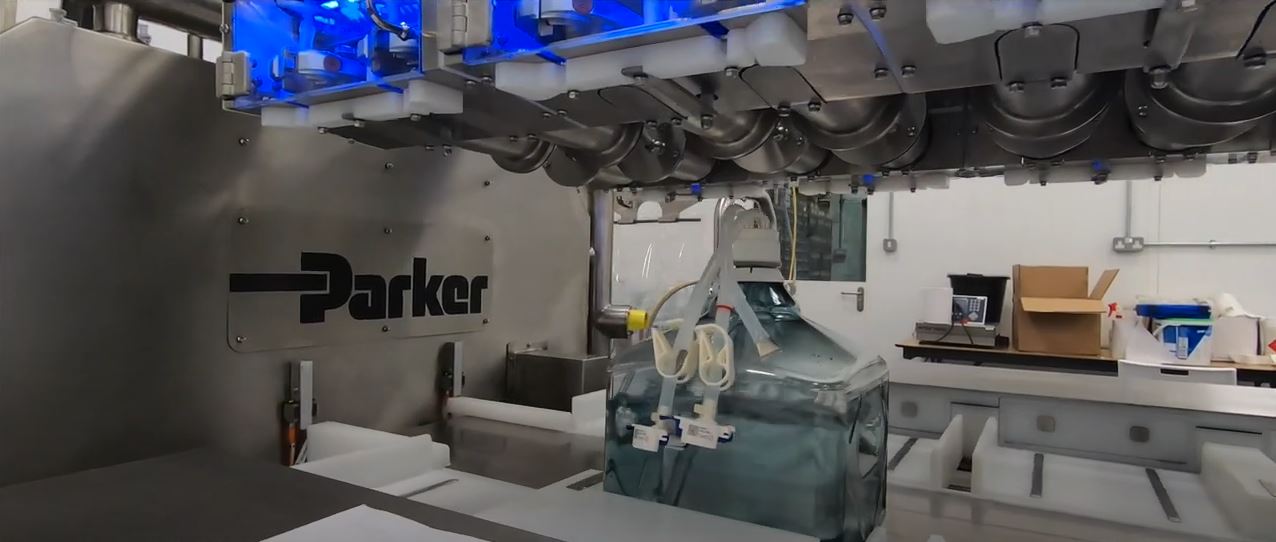
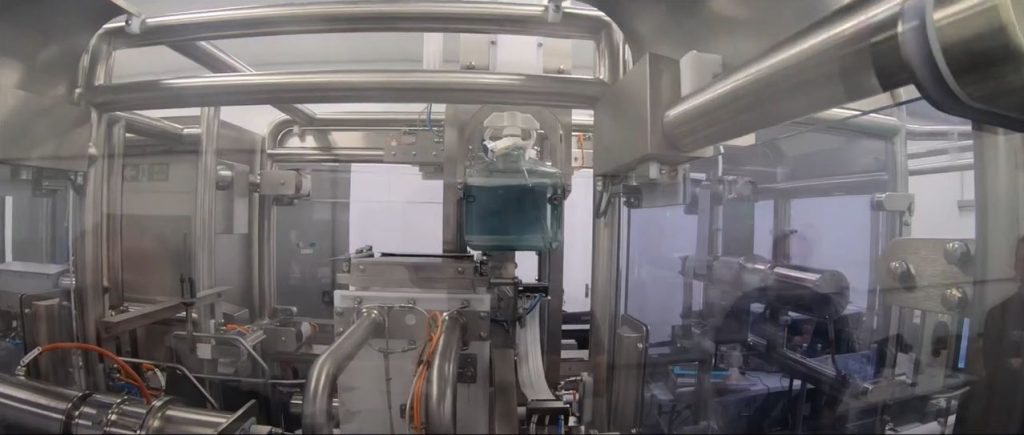
ISOMA’s completely custom auto-filling and bagging line consists of three major stages: filling 10-liter polyethylene-terephthalate (PET) containers with the vaccine, labeling the containers and then bagging them up for transport. We included a total of nine PureSteel® belts of six varying lengths throughout the system that could convey horizontally and lift vertically. The horizontal belts are used within the filling and labeling areas to push the containers forward and position them in the appropriate locations.

Further down the line in the bagging area, the system contains several timing pulleys and open belts that lift the containers, insert them into bags and station them at the end of the line. When full, each of the containers weighs 27 lbs. (12 kg), which is too great a strain for a belt made from plastic. Neoprene, rubber, plastic and similar materials are prone to stretching, which throws off the timing, accuracy and repeatability of the process. However, stainless steel has a high modulus of elasticity, giving our PureSteel® belts a high strength-to-weight ratio and making them virtually non-stretchable.

All the belts chosen for this project were created from austenitic stainless steel 316L. Due to this alloy’s smooth, impermeable surface, there is no opportunity for the invasion of microbes or bacteria. The steel belts are also capable of withstanding freezing temperatures without damage, making them the ideal choice for this project. To ensure optimal accuracy, Belt Technologies also supplied patented timing pulleys to match the provided belts.

The Result

Once the vaccine is bottled and bagged, it is transported to plants around the world and segmented into smaller vials, which are then distributed to pharmacies and other locations and provided to the general public. Without conveyor manufacturers like ISOMA, this expedited response to the COVID-19 pandemic wouldn’t have been possible.

The ongoing pandemic crisis demanded rapid belt development and testing, which might normally take years for such a complex machine. However, through intense cooperation and teamwork by both companies, the final result was achieved within a matter of months. This partnership was ISOMA’s first foray into the pharmaceutical packaging field. Not only was the job extremely successful in its own right, but it has allowed the customer to further expand their capabilities into the production of medical packaging machinery, and has opened up new business opportunities for them.

The Company: Located in Derbyshire, England, ISOMA specializes in conveying systems that encompass the entire product-handling process.

 The Problem: In mid-2021, ISOMA was chosen to create a machine that could expedite the packaging process of a newly developed COVID-19 vaccine, and needed belts that were both strong and hygienic.

The Solution: ISOMA installed a total of nine of our PureSteel® belts throughout their packaging system, to convey horizontally and lift vertically.

The Results: Not only was this job extremely successful in its own right, but it has allowed the customer to further expand their capabilities into the production of medical packaging machinery, creating new business opportunities.

A Solution for Battery Production

Curtain coating method for more efficient battery production

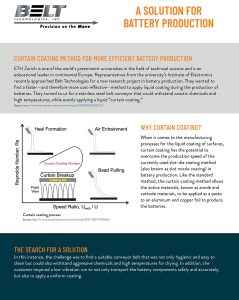
ETH Zurich is one of the world’s preeminent universities in the field of technical science and is an educational leader in continental Europe. Representatives from the university’s Institute of Electronics recently approached Belt Technologies for a new research project in battery production. They wanted to find a faster—and therefore more cost-effective—method to apply liquid coating during the production of batteries. They turned to us for a stainless steel belt conveyor that could withstand caustic chemicals and high temperatures, while evenly applying a liquid “curtain coating.”

Source: https://www.sciencedirect.com/science/article/pii/S2589004221000237

Source: https://www.sciencedirect.com/science/article/pii/S0377025717305554

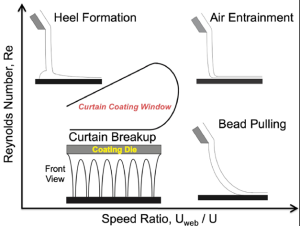
Curtain coating process

Why Curtain Coating?

When it comes to the manufacturing processes for the liquid coating of surfaces, curtain coating has the potential to overcome the production speed of the currently used slot-die coating method (also known as slot nozzle coating) in battery production. Like the standard method, the curtain coating method allows the active materials, known as anode and cathode materials, to be applied as a paste to an aluminum and copper foil to produce the batteries.

The Search for a Solution

In this instance, the challenge was to find a suitable conveyor belt that was not only hygienic and easy to clean but could also withstand aggressive chemicals and high temperatures for drying. In addition, the customer required a low-vibration run to not only transport the battery components safely and accurately, but also to apply a uniform coating.

Conventional flat belts were out of the question due to their decomposability through chemicals and particle generation. After a long search, the customer discovered a picture of an endless steel conveyor belt for chocolate production and came looking for us. After an extensive examination of their setup, we determined that a PureSteel® endless metal belt would be the optimal transport solution for the curtain coating system.

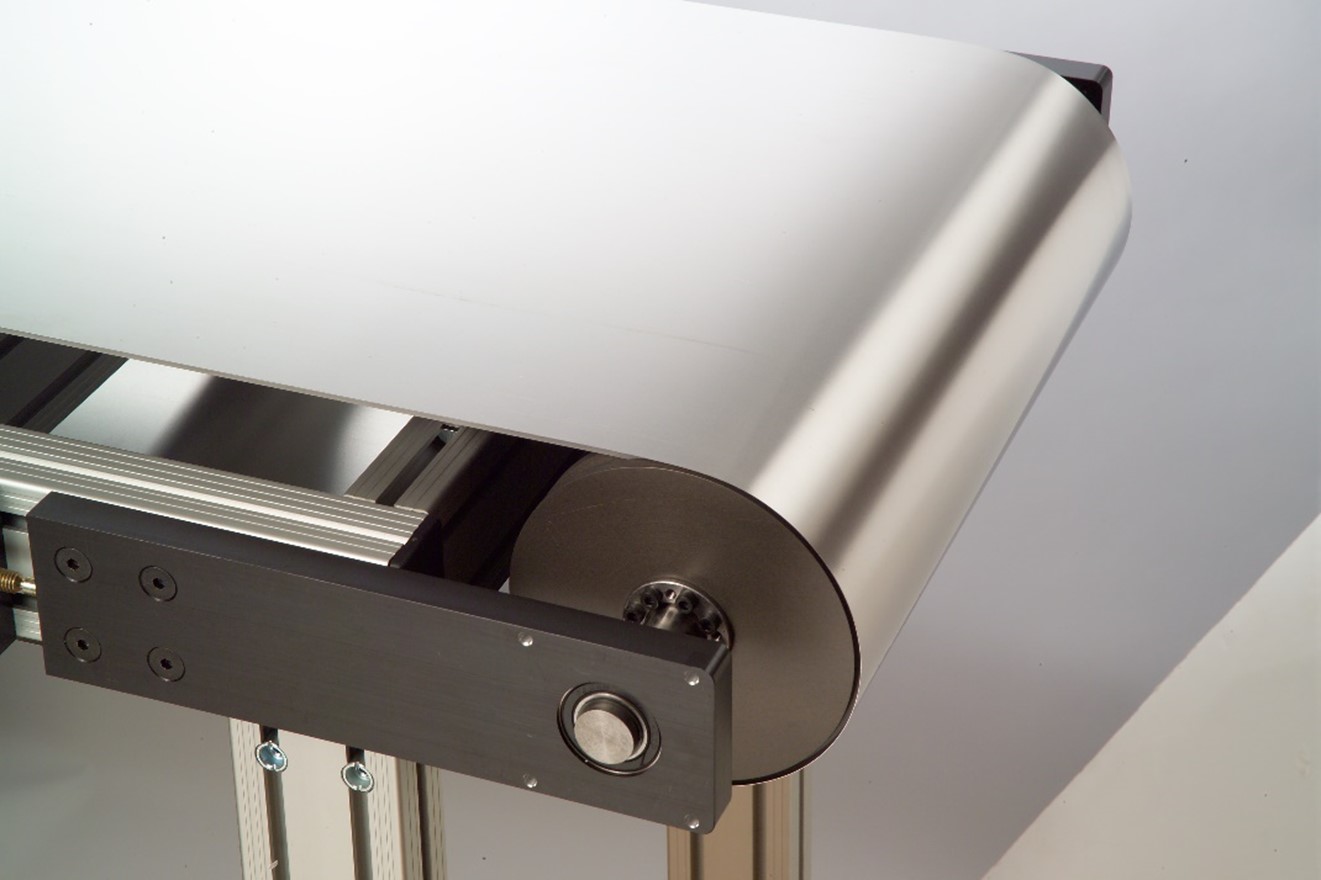
PureSeteel-enldess-metal-belt

Throughout the development project, constant cooperation and communication between Belt Technologies and ETH Zurich led to the delivery of the desired belt, as well as the associated drive and deflection rollers made of aluminum with anodized hardness coating, which were installed in the transport unit designed by ETH Zurich.

Battery quality depends on a precise and error-free coating. Because of this, the fluid-dynamic properties of the paste had to be adapted per the new method. Therefore, the team carried out a CFD simulation of the coating to further investigate the fluid-dynamic behavior of various liquids at the impact point, as well as a laminar distribution over the carrier material. For the experiment, the liquids were applied using a slot-die method and different coating thicknesses were determined based on the different speeds of the belt. The results of the investigation served as a “proof of concept” of the curtain coating method’s ability to enable improved cycle times.

Due to the extremely positive results, it can also be concluded that thanks to the flat and robust steel belt, thinner and less stable current collectors (foils) could be selected for the coating. This would allow for a reduction of “dead weight” in the battery.

Source: https://www.sciencedirect.com/science/article/pii/S2542435121001501

The Search for a Solution

In summary, the project determined that the curtain coating method—in combination with the PureSteel® endless metal belt—can enable chemical, thermal and mechanical stability with simultaneously increased production speed and better cost efficiency for battery production.

If you think you could benefit from one of our PureSteel® products or our engineering expertise, contact our sales engineers today.

Source: https://www.nature.com/articles/s41467-019-09933-0

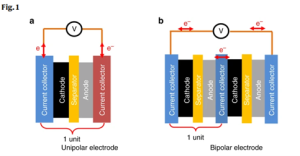
Typical battery design
download-cover

Download

Vorhangbeschichtungsmethode für die effizientere Batterieherstellung

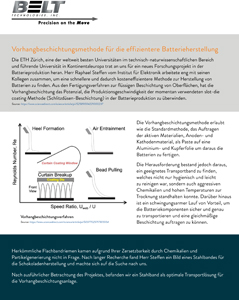
Die ETH Zürich, eine der weltweit besten Universitäten im technisch-naturwissenschaftlichen Bereich und führende Universität in Kontinentaleuropa trat an uns für ein neues Forschungsprojekt in der Batterieproduktion heran. Herr Raphael Steffen vom Institut für Elektronik arbeitete eng mit seinen Kollegen zusammen, um eine schnellere und dadurch kosteneffizientere Methode zur Herstellung von Batterien zu finden. Aus den Fertigungsverfahren zur flüssigen Beschichtung von Oberflächen, hat die Vorhangbeschichtung das Potenzial, die Produktionsgeschwindigkeit der momentan verwendeten slot-die coating Methode (Schlitzdüsen-Beschichtung) in der Batterieproduktion zu überwinden.Source: https://www.sciencedirect.com/science/article/pii/S2589004221000237

Curtain coating process
Vorhangbeschichtungsverfahren

Source: https://www.sciencedirect.com/science/article/pii/S0377025717305554

Die Vorhangbeschichtungsmethode erlaubt wie die Standardmethode, das Auftragen der aktiven Materialien, Anoden- und Kathodenmaterial, als Paste auf eine Aluminium- und Kupferfolie um daraus die Batterien zu fertigen.

Die Herausforderung bestand jedoch daraus, ein geeignetes Transportband zu finden, welches nicht nur hygienisch und leicht zu reinigen war, sondern auch aggressiven Chemikalien und hohen Temperaturen zur Trocknung standhalten konnte. Darüber hinaus ist ein schwingungsarmer Lauf von Vorteil, um die Batteriekomponenten sicher und genau zu transportieren und eine gleichmäßige Beschichtung auftragen zu können.

Herkömmliche Flachbandriemen kamen aufgrund Ihrer Zersetzbarkeit durch Chemikalien und Partikelgenerierung nicht in Frage. Nach langer Recherche fand Herr Steffen ein Bild eines Stahlbandes für die Schokoladenherstellung und machte sich auf die Suche nach uns.

Nach ausführlicher Betrachtung des Projektes, befanden wir ein Stahlband als optimale Transportlösung für die Vorhangbeschichtungsanlage.

PureSeteel-enldess-metal-belt

Die gute Zusammenarbeit und stetige Kommunikation zwischen Belt Technologies und der ETH Zürich in diesem Entwicklungsprojekt führte zur Lieferung eines endlosverschweißten Edelstahlbandes und den dazugehörigen Antriebs- und Umlenkrollen aus Aluminium mit eloxierter Härtebeschichtung, welche in die von der ETH entworfene Transporteinheit verbaut wurden.

Die Qualität der Batterie ist dabei abhängig von einer präzisen und fehlerfreien Beschichtung. Dafür müssen die fluiddynamischen Eigenschaften der Paste entsprechend der neuen Methode angepasst werden. Die Aufgabe bestand nun darin eine CFD Simulation der Beschichtung durchzuführen, um damit das fluiddynamische Verhalten verschiedener Flüssigkeiten am Aufprallpunkt sowie eine laminare Verteilung über des Trägermaterials näher zu untersuchen. Experimentell wurden die Flüssigkeiten mittels Slot-Die Verfahren aufgetragen und verschiedene Beschichtungsstärken anhand der unterschiedlichen Geschwindigkeiten des Bandes bestimmt.

Die Ergebnisse der Untersuchung dienen als „proof of concept“ der Vorhangbeschichtungsmethode um verbesserten Taktzeiten zu ermöglichen.

Aufgrund der positiven Resultate lässt sich vermuten, dass Dank des flachen und robusten Stahlbandes, dünnere und weniger stabile Stromabnehmer (Folien) für die Beschichtung ausgewählt werden könnten. Dies würde erlauben „Dead weight“ in der Batterie zu reduzieren. (Source: https://www.sciencedirect.com/science/article/pii/S2542435121001501)

Zusammengefasst ist die Vorhangbeschichtungsmethode in Kombination mit dem Stahlband eine Möglichkeit um die chemische, thermische und mechanische Stabilität bei gleichzeitig erhöhter Produktionsgeschwindigkeit und somit bessere Kosteneffizienz für die Batterieproduktion zu ermöglichen.


Typical battery design

Typischer Aufbau einer Batterie (Source: https://www.nature.com/articles/s41467-019-09933-0)
Könnte das Stahlband die Zukunft der fortschrittlichen Batterieproduktion sein?
Entscheiden Sie selbst und wenden Sie sich noch heute an unsere Vertriebsingenieure.


002937_Belt_ETHZurichCaseStudy_German-1

Download

Puresteel® Metal Belts Provide An Efficient, Hygienic, Long-Lasting Solution For A Tobacco Machinery Manufacturer

tobacco belt

Much like the food industry, tobacco and tobacco products need to remain sanitary throughout the production process before they come into contact with customers. Since the products are designed to be ingested, eliminating the presence of potentially harmful bacteria at all points of contact, from handling to the rolling and packaging process, is critical. Molins (MPRD Ltd.) has been a leader in the tobacco industry for more than a century, known for offering the lowest cost and best quality. Prior to their partnership with Belt Technologies, they were in the market for an efficient and hygienic solution to transport raw tobacco into the cigarette production line. We rolled out a solution that has served them for decades.

The Company

Molins (MPRD Ltd.), a major supplier of machines, spares and related services to the tobacco industry. They have been a leader in the industry for more than a century, establishing a presence around the globe.

The Problem

The number one cause for concern with tobacco production machinery is hygiene, with product efficiency as an important secondary factor. Molins found that the belts used in their machinery did not offer a tailored, hygienic solution capable of transporting tobacco at high speeds. At the time, traditional conveyor belts were made of linen, which could easily degrade and wear down, halting production and introducing contaminants into the production process. Molins required a conveyor that was both hygienic and capable of keeping the tobacco on the line, and turned to Belt Technologies for assistance.

The Solution

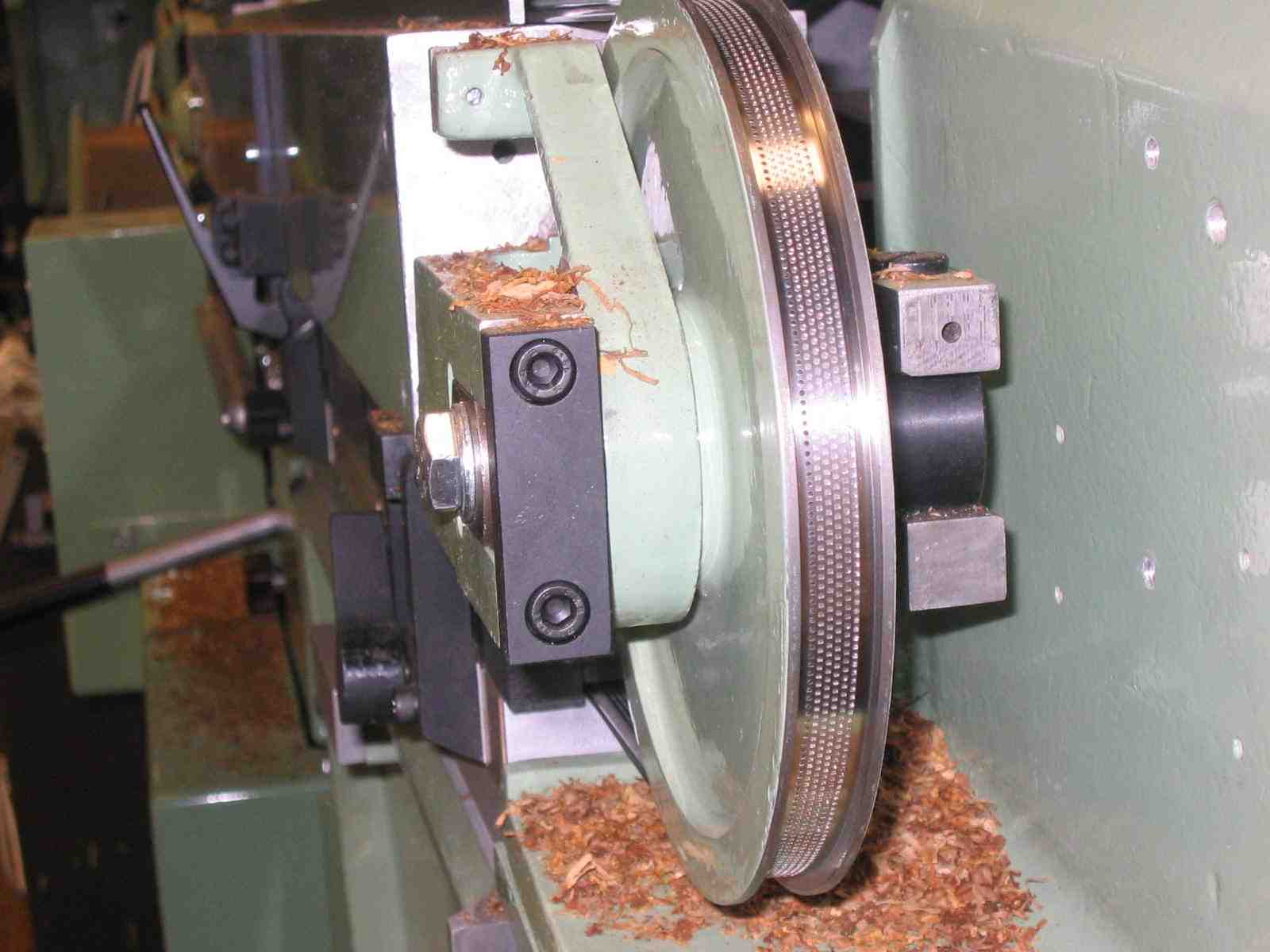
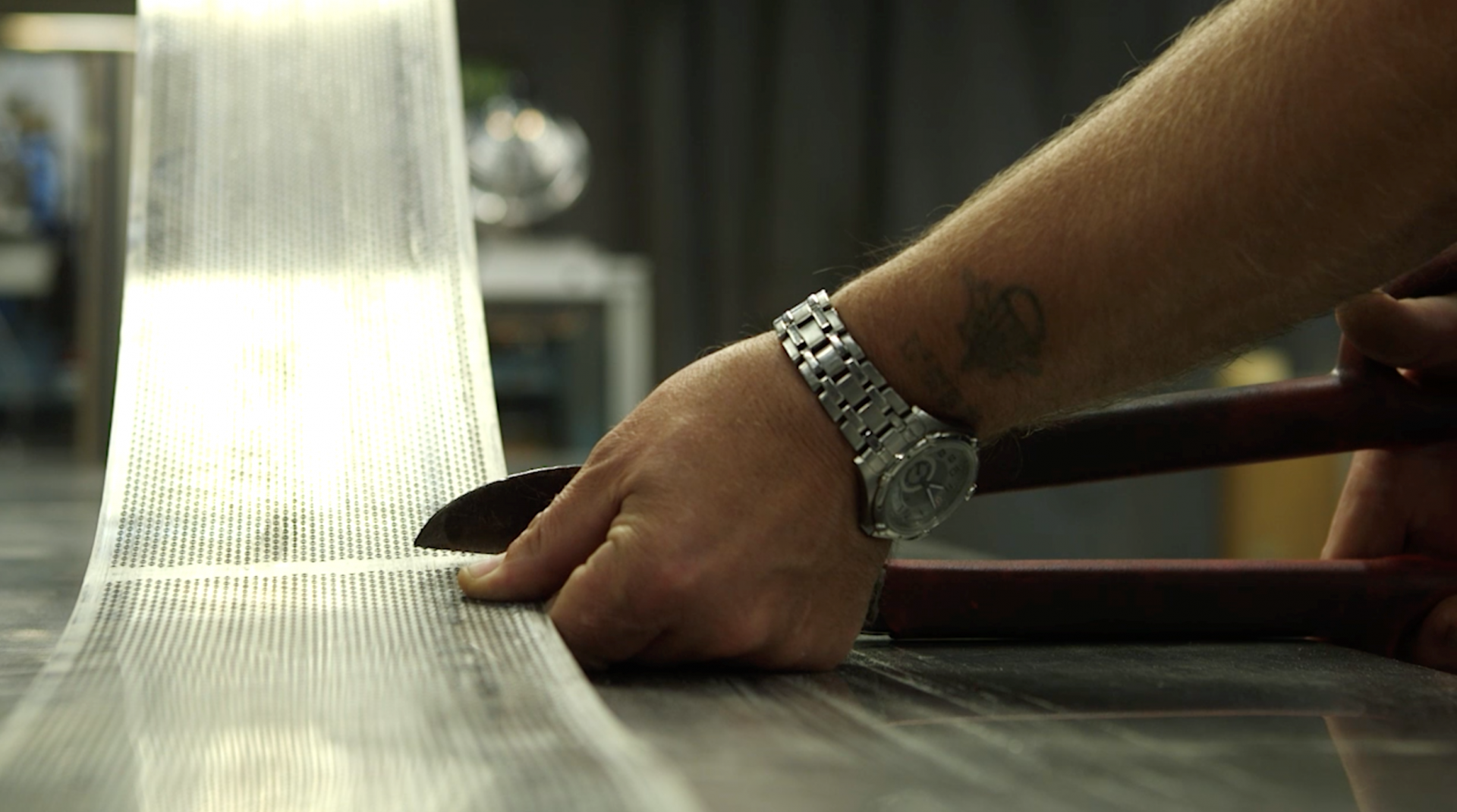
We presented Molins with an array of perforated, stainless steel suction bands to be used in conjunction with vacuum conveyors. The holes in the recommended belts would allow the tobacco to be transported under vacuum, retaining it on the line. Some of the provided designs also had a textured surface, known as “burr,” which gripped the tobacco and further ensured none was lost during transport down the conveyor. This “gripper” belt was unique as it required steel with a softer temper to allow the belt to be easily manipulated, perforated and texturized with the burr surface. Molins was greatly impressed, especially with the hygienic benefits of the stainless steel conveyors. Unlike alternatives, PureSteel® conveyor belts are resistant to bacteria, easy to clean and compliant with even the strictest USDA requirements. Additionally, they don’t generate component friction and therefore do not need lubrication, reducing the amount of maintenance required and keeping the conveyor system clean.

The Result

We provided Molins with an array of stainless steel suction bands with 15 unique perforation patterns (some with burr, others without). This range of products accommodated the conveying of loose tobacco as well as the range of other tobacco products made by Molins. Today, Molins continues to use the solutions provided by Belt in a variety of high-speed cigarette production machine models, producing up to 5,000 filter tip items per minute. We continue to work on the spare parts market with Molins, and they have recently sold new machinery, incorporating our original belt design for use in the growing hemp cigarette industry.