Proper belt installation and removal safeguards automated conveyor systems against accidental damage, enables accurate belt tracking, and helps to extend the life of the belt by reducing unnecessary wear or friction. This step-by-step tutorial will demonstrate the correct method to install and replace a solid, endless metal belt for your conveyor system.
Recently, a customer from a previous project contacted Belt Technologies with a problem. Our engineers had provided them with a conveyor belt for the production of electrical connectors. Unfortunately, they were experiencing issues with the belt after it was installed in their system and they needed help identifying the source of the problem. Members of our team traveled to their location in Mexico to help their team troubleshoot the belt and provide them with a lasting solution.
Troubleshooting a Short Belt Lifespan
Originally, Belt Technologies produced a custom stainless steel conveyor belt that would support unique nesting attachments designed to hold electrical connectors in place as they were assembled. The belt was sent to a secondary builder, who then attached the custom fixtures. The individual fixtures were very heavy, weighing 1.45 pounds each; there were 48 fixtures in total. Because of the pulley dimensions, the belt was relatively thin. However, due to the high strength-to-weight ratio of stainless steel, the significant weight of the fixtures should not have caused the belt to fail so early in its operating lifespan.
Belt engineers traveled onsite to the customer plant to assist the end user with the setup and see if there was a solution for extending the belt life. After examining the system in operation, our engineers were able to determine that there was not enough clearance left between the fixtures on the belt and the legs of the system. As the fixtures traveled around the pulleys, they were striking the legs. Combined with minor alignment issues from incorrect installation, the repeated impacts contributed to chordal vibrations; these added stressors lead to fractures along the perforations of the belt and ultimately cause it to fail.
Proper Tensioning and Tracking Solutions
Our engineers were able to troubleshoot the issue and made small onsite adjustments to enhance productivity and save costs by reducing downtime and maintenance. They also helped train some of the end user’s employees on proper tracking and tensioning of the belt. Properly tensioning the belt fixed the underlying alignment issues with the pulleys that were contributing to the belt failure. The legs of the system were adjusted to provide enough clearance for the fixtures and prevent the repeated collisions that were damaging the belt.
Your System’s Success Is Our Priority
Our team was more than willing to work with the end user onsite to evaluate the machine as it ran, assess each element, and identify the cause of the issue. At Belt Technologies, the success of your automated system is our priority. We will always go the extra mile to ensure customers get the maximum possible lifespan from their conveyor belts.
For more information about custom stainless steel belts for your conveyor system,contact us today.
Belt tracking is accomplished by increasing or decreasing the tension on one edge of the belt in relation to the other edge. It is a process similar to tensioning the belt during installation. If the tension on one side of the belt is too high, the belt will begin tracking off the pulley toward the side with lower tension. Ignoring these tracking issues will shorten the overall lifespan of the belt. Belt Technologies has a variety of strategies available to counteract negative tracking stresses and keep your metal conveyor belt system in alignment.
Belt tracking is accomplished by increasing or decreasing the tension on one edge of the belt in relation to the other edge. It is a process similar to tensioning the belt during installation. If the tension on one side of the belt is too high, the belt will begin tracking off the pulley toward the side with lower tension. Adjustments can be made to increase or decrease tension and stabilize the belt. Ignoring these tracking issues will shorten the overall lifespan of the belt, cause inaccurate product placement, and ultimately result in product damage.
What Causes Conveyor Belt Tracking Issues?
Stainless steel conveyor belts are virtually non-stretchable and will not yield under tension, which can make tracking more difficult. The belt cannot naturally flex to compensate for factors that will gradually draw the belt off track. Tracking issues are typically caused by:
Poor system alignment
Uncontrolled pulley shaft deflection
Differential loading
Belt camber (edge bow, or the deviation of a belt edge from a straight line)
Every type of conveyor belt has some camber. Stainless steel belts typically have a camber of less than 0.050” (1.27 mm) in 8’ (2.44 mm). In any squared, two-pulley system, one edge of the belt will be tensioned more than its counterpart because it has a shorter edge circumference. This variation will inevitably cause the belt to track away from the tighter edge when the belt is rotated. The primary objective of any tracking technique is to prevent or counteract the accumulative negative tracking stresses.
Methods to Resolve or Prevent Belt Tracking Problems
Belt Technologies has a variety of strategies available to counteract negative tracking stresses and keep your metal conveyor belt system in alignment.
Manual Pulley Axis Adjustment
Pulleys can be manually adjusted to compensate for tracking issues.
For most metal conveyor belt systems, manual adjustment of the pulley axes is an effective way to compensate for tracking issues. Belt edge tensions are adjusted in a controlled manner to steer the belt into an aligned position on the pulley. The technique can be used with both flat-faced and crowned-faced pulleys, though Belt Technologies does not recommend using crowned-faced pulleys in any metal conveyor belt systems.
Ideally, both the drive and idler pulleys will have adjustable axes for precise adjustments. However, typically only the idler pulley will feature adjustable axes, because the drive pulley usually interfaces with motors and other power transmission devices, making it more difficult to adjust.
Forced Tracking
V-guided tracking is a reliable means of forced tracking for metal conveyor belts.
For some systems, a simple pulley axis adjustment may not be enough to completely eliminate or prevent improper tracking. Belt Technologies engineers can provide design feedback on the best strategy for achieving proper tracking in existing systems, such as installing cam followers or glass-filled Teflon® flanges. Forced tracking techniques can potentially shorten the expected life of a belt, but our experts can adjust the system in various ways—such as using a thicker conveyor belt—to mitigate these effects.
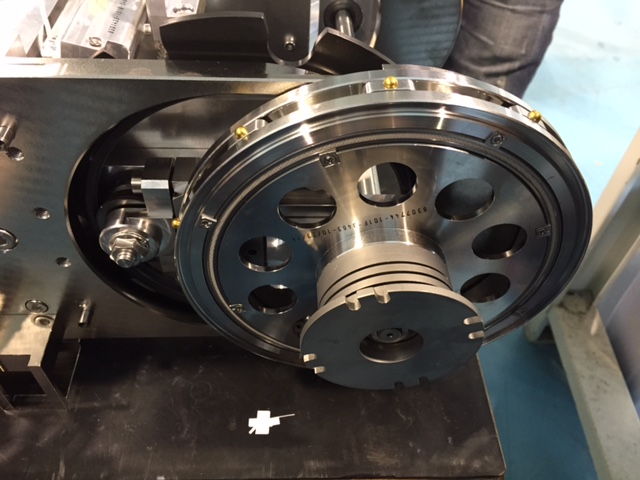
Belt Technologies developed the Independent Steerable Pulley to make tracking adjustments easier.
The independent steerable pulley, or ISP, is an innovative concept designed and engineered by Belt Technologies. It can be used in two-pulley conveyor systems, systems with multiple idler pulleys on a common shaft, or systems with serpentine or complex belt paths. The ISP changes the tension relationships across the width of the belt by adjusting the angle of the pulley in relation to the belt.
Rather than moving the pulley shaft with a pillow-block adjustment, the ISP fits a steering collar and sealed bearing assembly to the body of the pulley. When rotated, the steering collar changes the angle of the pulley body, resulting in controlled, bidirectional movement of the belt across the pulley face. The ISP provides a simple method of steering flat metal belts and is exclusively available from Belt Technologies.
Our engineers can design and build custom conveyor systems with preventative tracking measures to address the requirements of your specific system. They can also provide troubleshooting and support for existing systems that are experiencing tracking issues. To learn more about tracking solutions for stainless steel metal belts, contact the experts at Belt Technologies today.
This site is registered on wpml.org as a development site. Switch to a production site key to remove this banner.
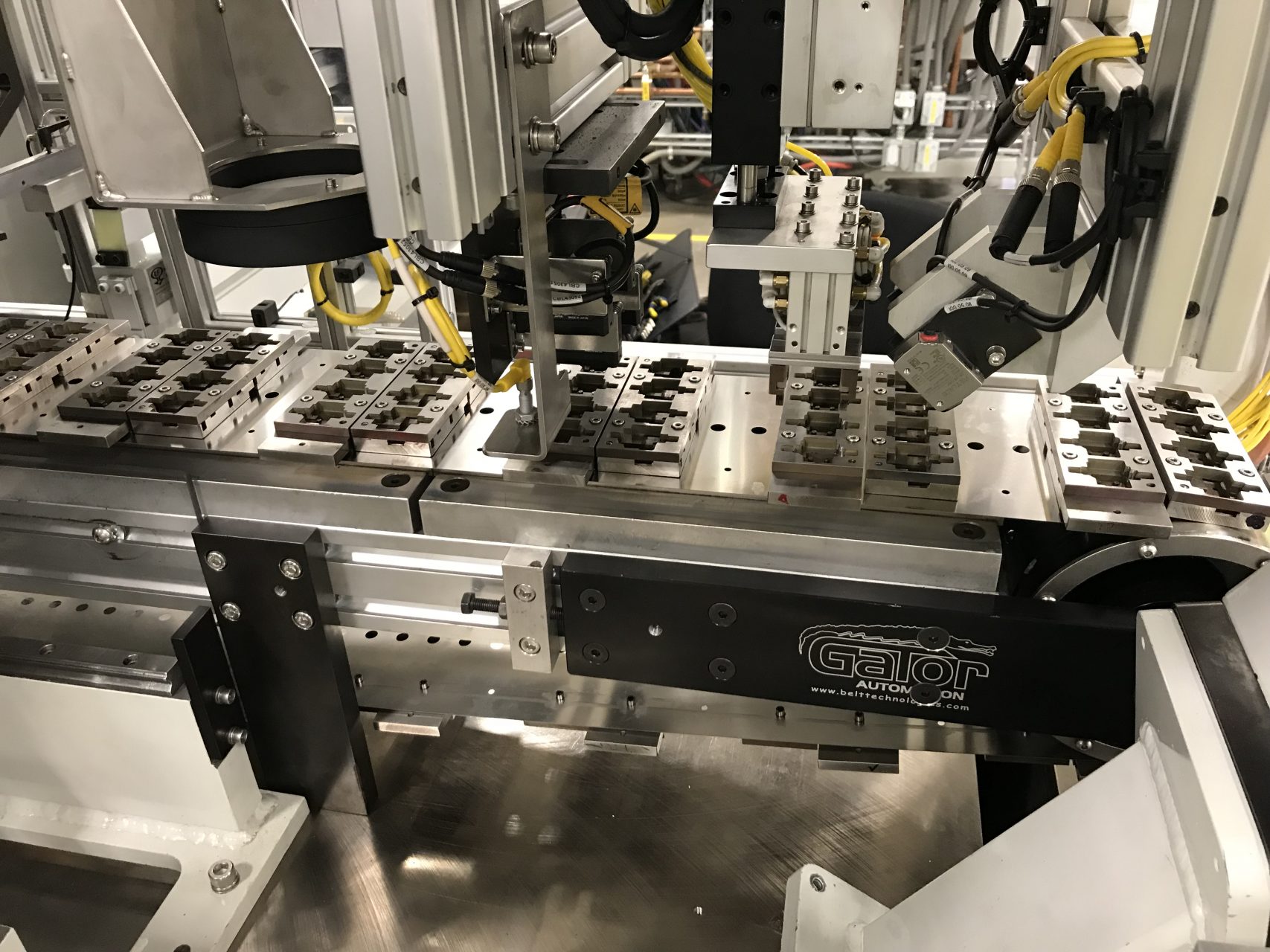
 Originally, Belt Technologies produced a custom stainless steel conveyor belt that would support unique nesting attachments designed to hold electrical connectors in place as they were assembled. The belt was sent to a secondary builder, who then attached the custom fixtures. The individual fixtures were very heavy, weighing 1.45 pounds each; there were 48 fixtures in total. Because of the pulley dimensions, the belt was relatively thin. However, due to the high strength-to-weight ratio of stainless steel, the significant weight of the fixtures should not have caused the belt to fail so early in its operating lifespan.