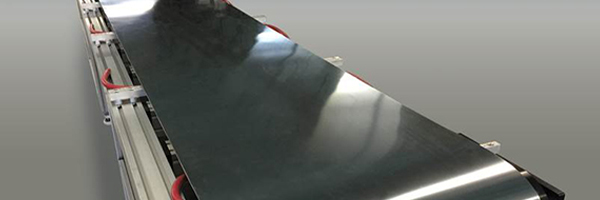
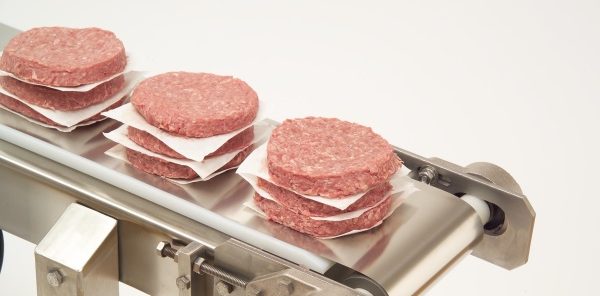
Belt Technologies has been working with OEMs specializing in the automated food processing industry for decades. Recently, a new food industry customer requested our help in designing and producing a stainless steel conveyor belt for a system designed to freeze breaded meat products. The customer’s engineers were seeking a way to convey the product through a spiral drum freezer on a solid metal belt.
Metal Belts Are Ideal for Virtually Any Food Processing Application
Solid metal conveyor belts are ideal for automated food processing applications. They do not outgas or require lubrication like other belt materials, so there is no risk to the flavor or quality of edible products. Additionally, metal belts will not fray or generate particulates that could contaminate food products and potentially endanger consumers. The flat, nonporous surface of stainless steel does not absorb bacteria and can easily be cleaned with chemical sprays, pressure washes, high powered steam, and more. Perhaps most importantly, metal belts are highly resistant to extremes in temperature, which gives them the ability to withstand the various cooking and freezing processes that food products are subjected to during manufacturing.
Maintain Optimal Functionality in Freezing Temperatures
For this particular food processing application, the customer was improving upon a system that was used to freeze webs of 24” wide, ½” thick, processed meat. The meat product would be compressed at high speeds between a freezing drum and the belt. The change to a spiral freezing drum was expected to increase production throughput by more than 10x the original processing speed.
The customer’s engineering team initially had questions in regards to how a seamless metal belt would react to operating conditions below -40℉. Their initial prototype used a Teflon belt but they knew this material would not work in the freezing conditions required. Belt Technologies has provided metal belts for a variety of freezing applications, including cryogenic processes for the pharmaceutical industry. Experienced members of the Belt Technologies team went onsite to examine the customer’s prototype in person. After reviewing the prototype, our engineers were able to assure the client that stainless steel, which has a very high resistance to extreme temperatures, would be the best material option.
Belt Technicians Can Help You Solve Engineering Challenges
The client’s new system design presented our engineering team with a unique challenge: how to track, tension and install a solid metal belt that could navigate a complex belt path with many bends? Originally, the design called for a seamless, endless belt—however, it became apparent that this type of belt would not work for this system. Belt Technologies developed a custom piano hinge solution with a central shaft. This unique combination of a solid metal belt with a piano hinge termination would make it easier to clean and load the machine.
The customer was very satisfied with the successful solutions and level of attentive support provided by the Belt Technologies engineering team. If you have an automated food processing challenge, contact the experts at Belt Technologies today.