Belt Technologies Logo

Medical Adhesive Curing with Stainless Steel Conveyor

Our engineering team recently took on a project for a medical manufacturing application. The customer would be assembling an automated conveyor system for the production of medical adhesive. They were seeking a conveyor belt material that would be able to transport the thin plastic film through the adhesive-curing process.

Heat Curing Adhesive onto Plastic Film

To produce the medical adhesive, a thin plastic film is laid on the conveyor belt. It is then sprayed with an even coat of adhesive material. The coated plastic is then transported through a heating process to cure the adhesive.

The client required a conveyor belt with limited deviation in thickness and the ability to transport the plastic film quickly and accurately. Because this was a medical application, the belt needed to be extremely clean to operate in order to prevent particulates or foreign particles from adhering to or contaminating the adhesive. Curing the adhesive to the plastic film requires the belt material to be able to withstand temperatures around 200°F continuously.

Highly Hygienic Stainless Steel Is Perfect for Medical Applications

Stainless steel is an ideal choice for medical and pharmaceutical applications due to its unique physical properties. The smooth, impermeable surface of a stainless steel conveyor belt is highly resistant to bacteria and it does not require lubrication to operate. Additionally, metal conveyor belts do not outgas or generate particulates, which minimizes any risk of contamination to medical products being transported. A high resistance to corrosion enables stainless steel belts to withstand virtually any cleaning method, including high-pressure wash, chemical cleansers, and high-pressure steam.

The properties of stainless steel also include a high resistance to temperature extremes. While there are many different grades of stainless steel—each able to withstand a specific range of temperaturesnearly all varieties are capable of operating in the temperatures specified by this customer.

Achieve Smooth, Reliable Operations with Metal Belt Conveyors

Belt Technologies engineers provided the customer with a solid, stainless steel conveyor belt with no deviation in thickness that would provide accurate, repeatable results. The clean, sanitary surface of the belt and the high temperature resistance of stainless steel ensures the medical adhesive will be able to cure quickly and cleanly with very little risk of contamination.

For custom metal conveyor belt solutions to automation challenges, contact the experts at Belt Technologies, Inc.
Belt Technologies Designs and Builds Custom Stainless Steel Conveyor System for Packaging System Manufacturer

A US-based OEM specializing in the production of industrial automation and packaging systems for manufacturers recently approached Belt Technologies, Inc. The OEM needed help designing and manufacturing a metal conveyor belt that could be integrated with existing equipment as part of an automated zip tie production system. When it became clear they needed help with the metal conveyor belt, they went to the experts at Belt Technologies for design feedback and engineering support.

A Unique System Challenge Requires Input from the Metal Conveyor Belt Specialists

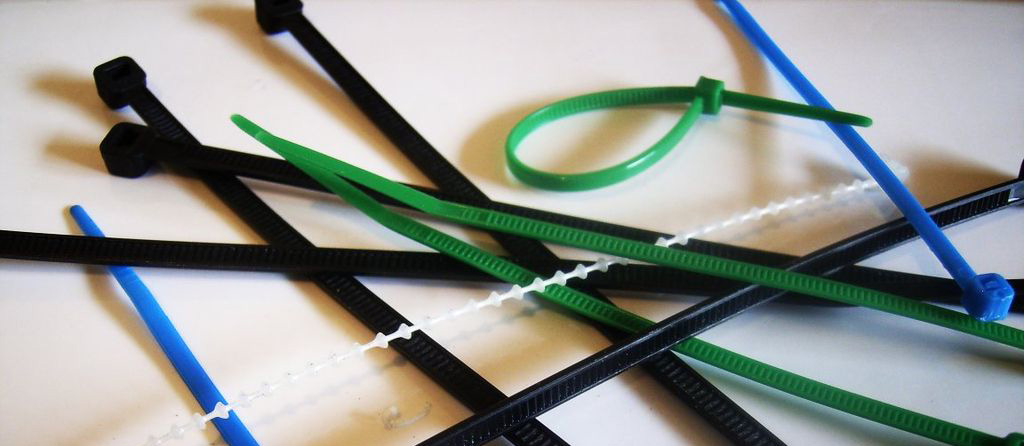
The purpose of the system was to transport groupings of plastic zip ties through multiple processes as part of a production line. The OEM needed a belt that could accommodate the system’s custom carriers while moving the zip ties through production.

The zip ties are first collected into the groupings, known as nests. The nests are inspected, indexed, and then passed through a laser cutter that separates the ties. The excess plastic is removed from the nested zip ties and drops through a hole in the primary belt to a secondary belt, where it is transported away for reuse or disposal. The zip ties proceed to the next stage of production.

Design Support and Collaboration Creates Customized Automation Solutions

The customer came to Belt Technologies with a strong background in engineering automated production equipment. Much of the initial design was set in place, including the customer’s design for the special carriers. Belt Technologies’ engineers worked with the customer on some of the more challenging aspects, such as deciding how the nest carriers would attach to the belt and what methods would most effectively assist belt tracking.

With the added design support from Belt Technologies, the final product was a 301-series stainless steel conveyor belt with large pockets for relief and special carrier attachments designed to hold the zip ties in place. With the double layer system for removing the excess plastic, accurate tracking was imperative and the belt is now force-tracked with V-guides to maintain alignment.

For this project, the new design was successfully integrated into the production line, which is still under construction. Although this system is still in its early stages, the customer was so satisfied with the product that they have already ordered a second, larger version to accommodate production of longer zip ties.

Your System Success Is Our Priority

The most popular question we are asked is “Why metal belts?” Many OEMs that produce equipment for industrial automation tasks will turn to Belt Technologies because our engineers understand the inherent properties and benefits of metal belts. Customers require our engineers’ support to predict how metal belts will perform under specific conditions. When one of our engineers works with a customer, the first priority is to outline the benefits of metal belts as they pertain to the specific needs and requirements of the application.

Could your automated system design benefit from the experience of dedicated metal conveyor belt engineers? Contact the experts at Belt Technologies, Inc. today.