Belt Technologies Logo

Metal Conveyor Belt for a Vapor Deposition Process in High Vacuum

Belt Technologies, Inc. has been contacted by several customers specializing in manufacturing advanced vacuum deposition equipment. The machinery they develop is typically used to deposit micrometer- to nanometer-thin, functional coatings on materials such as glass, metal strips, wafers, and polymer films. These materials are typically used in products like solar panels, architectural glass, and smartphone displays.

Designing a Conveyor Belt for Micrometer and Nanometer Vapor Deposition

For this particular application, the customers usually seek a series of belts, pulleys, and timing elements. The belts are to be run in pairs, carrying a product to a high-vacuum chamber for a vapor deposition process.

Vapor deposition is a precise process used to coat products with a layer of material. These coatings are often extremely thin; the vapor deposition process can be used to deposit the material atom-by-atom or molecule-by-molecule. It is typically used for coating exceptionally sensitive materials and equipment. To be successful, the vapor deposition process requires a high-vacuum environment with zero risk of contamination.

No Room for Error: Stainless Steel Is Clean, Precise and Reliable

Once the material reaches the vacuum chamber and the chamber is closed, there is no room for adjustment if the belt tracks off course or the material shifts in transit. Therefore, it is necessary that the motion profile of the belt be reliably precise. The belts also have to be exceptionally clean in order to prevent contamination. Anything that could potentially cause a delay in production, such as belt realignment, maintenance, or decontamination would cost up to several thousand dollars an hour in lost production time.

Stainless steel is an ideal material choice for applications requiring cleanliness and accuracy. Metal belts made of stainless steel do not require lubrication, do not outgas, and do not generate particulates. They are excellent for clean room applications and high-vacuum environments. To ensure the product would be transported safely and would not slip on the belt, our team added attachments to the belt design.

Timing Elements Ensure Accurate, Repeatable Results

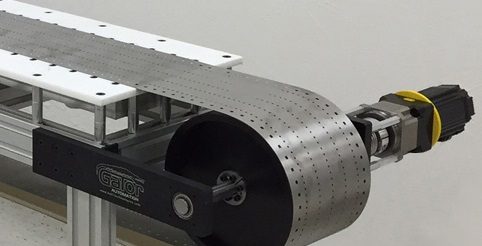
The customer’s equipment design requires a timing element to keep production running smoothly. Our team provides the client with metal conveyor belts fitted with custom attachments to keep the product in place; we also use timing pulleys to provide maximum accuracy. The timing pulleys are configured with specially designed evacuation holes around each timing element. This prevents air from getting trapped behind the timing ball and helps to avoid any interruption to the vacuum conditions inside the chamber.

The engineers at Belt Technologies, Inc. have the knowledge and capability to provide custom stainless steel conveyor belt solutions for virtually any application. Contact us today and find out how metal belts can improve your automated conveyor system.

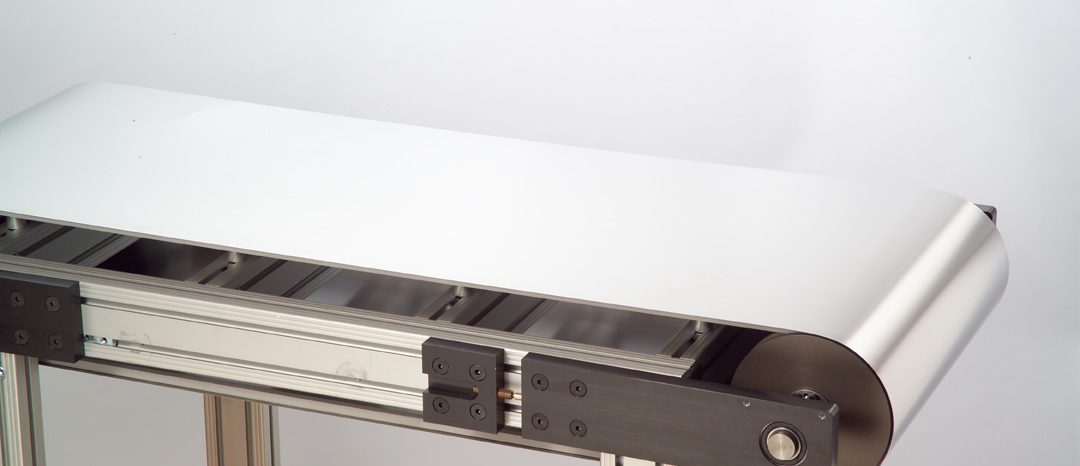
Medical Adhesive Curing with Stainless Steel Conveyor

Our engineering team recently took on a project for a medical manufacturing application. The customer would be assembling an automated conveyor system for the production of medical adhesive. They were seeking a conveyor belt material that would be able to transport the thin plastic film through the adhesive-curing process.

Heat Curing Adhesive onto Plastic Film

To produce the medical adhesive, a thin plastic film is laid on the conveyor belt. It is then sprayed with an even coat of adhesive material. The coated plastic is then transported through a heating process to cure the adhesive.

The client required a conveyor belt with limited deviation in thickness and the ability to transport the plastic film quickly and accurately. Because this was a medical application, the belt needed to be extremely clean to operate in order to prevent particulates or foreign particles from adhering to or contaminating the adhesive. Curing the adhesive to the plastic film requires the belt material to be able to withstand temperatures around 200°F continuously.

Highly Hygienic Stainless Steel Is Perfect for Medical Applications

Stainless steel is an ideal choice for medical and pharmaceutical applications due to its unique physical properties. The smooth, impermeable surface of a stainless steel conveyor belt is highly resistant to bacteria and it does not require lubrication to operate. Additionally, metal conveyor belts do not outgas or generate particulates, which minimizes any risk of contamination to medical products being transported. A high resistance to corrosion enables stainless steel belts to withstand virtually any cleaning method, including high-pressure wash, chemical cleansers, and high-pressure steam.

The properties of stainless steel also include a high resistance to temperature extremes. While there are many different grades of stainless steel—each able to withstand a specific range of temperaturesnearly all varieties are capable of operating in the temperatures specified by this customer.

Achieve Smooth, Reliable Operations with Metal Belt Conveyors

Belt Technologies engineers provided the customer with a solid, stainless steel conveyor belt with no deviation in thickness that would provide accurate, repeatable results. The clean, sanitary surface of the belt and the high temperature resistance of stainless steel ensures the medical adhesive will be able to cure quickly and cleanly with very little risk of contamination.

For custom metal conveyor belt solutions to automation challenges, contact the experts at Belt Technologies, Inc.

Stainless Steel Conveyor Belt Solution for Manufacturing Components with Sharp Metal Fragments

A distributor recently reached out to Belt Technologies on behalf of a small manufacturer in Europe. The manufacturer operated an automated system for punching steel and aluminum sheet metal to create components for its own customers. Once punched from the sheets, the metal pieces fell onto a conveyor belt for transportation, which is why they contacted our experts at Belt Technologies.

Inadequate Belt Materials Are Short-Lived and Require Frequent Replacement

The original conveyor belt used to transport the metal fragments was made of rubber. Unfortunately, the impact from the sharp metal fragments often damaged the easily impressionable rubber belt. Frequent cuts, tears, slices, and holes in the belt meant the belt had to be replaced too often, which cost the manufacturer time and money.

Stainless Steel Is Strong and Resilient to Physical Impact

Our team worked closely with the distributor to obtain the details of the end user’s application. A stainless steel conveyor belt was clearly the best option for transporting sharp metal. Our engineers recommended a simple, solid, metal friction drive belt to catch and transport the metal fragments.

Stainless steel is robust and able to withstand impact damage and scratches. Although a stainless steel conveyor may appear more expensive in the short term, its long lifespan and resilience would help the manufacturer avoid costly replacements and downtime for maintenance.

Longer Belt Lifespan Increases Production Volume

Rubber belts are attractive for their low upfront cost, but the frequent need for replacement can become expensive. Stainless steel conveyor belts have a long lifespan, enabling manufacturers to maximize product throughput and increase overall efficiency. Our engineers strive to develop cost-effective solutions to virtually any automated system issue. For this customer, the answer was a simple switch in materials. At this point, the stainless steel belt is installed and has proven to be an excellent fix for the problem.

Would your automated manufacturing system benefit from the resilience and strength of a stainless steel conveyor belt? Contact the experts at Belt Technologies, Inc. today.


Seamless Results for a Producer of PVC Plastic with Endless Metal Conveyor Belts

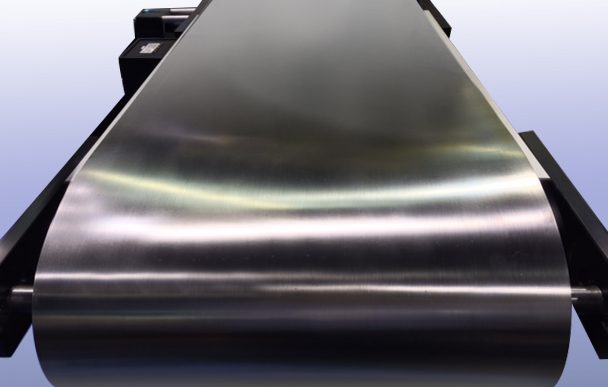
endless metal conveyor beltsA producer of PVC plastic recently approached Belt Technologies with a problem. They had been beta testing belt materials for their conveyor system and had not yet found a solution that would work. They needed a conveyor belt that could transport hot PVC plastic without leaving any marks on the surface of the plastic as it cooled. The silicone belt they had been testing was not working due to a seam in the belt that left a mark on the product when it cooled.
A Special Application: Extruding PVC Plastic

The customer was searching for a belt that would not leave impressions on the product they were extruding. The customer needed to extrude PVC plastic that was 1/2wide and 1/8thick onto a belt and then allow it to remain on the belt while cooling. The PVC plastic would be extruded at temperatures of 350°F to 400°F, so the belt needed to withstand these high temperatures.

Stainless steel metal conveyor belts have a high resistance to temperature, which make them a great choice for this type of application. Most importantly, the smooth surface of an endless metal belt allows hot plastic to cool without leaving any impressions in the PVC, thus preventing unnecessary damage to the product.

Choose Endless Metal Belts for a Smooth Product Finish

Endless metal belts deliver the ideal combination of precision, strength, and versatility. We manufacture metal belts by welding stainless steel into endless belts. Our welds are incredibly strong and can be weld-finished for better blending. Achieving flawless results when welding thin stainless steel belts is our specialty. With the endless metal belt from Belt Technologies, the customer was able to achieve the smooth product results they desired while maximizing product output and speed.

Optimum Results with Custom Coatings for Your Application

This customer wanted to prevent the hot plastic from adhering to the belt as it cooled, so we added a Teflon coating to the Belt. Belt Technologies offers various Teflon coatings with benefits including food-grade qualification, abrasion resistance, and chemical resistance. For this customer, we chose a Teflon with good release characteristics to make sure the product would not stick to the belt.

Belt Technologies has the ability to design and manufacture custom metal conveyor belts for virtually any application. Surface coatings and surface treatments help expand the potential uses for stainless steel metal belts. BTI provides several options, including Teflon, silicone, polyurethane, and more.

Looking to increase the efficiency of your conveyor system and get better product results every time? Call or request a quote today!


Conveyor System Upgrades to a Stainless Steel Belt for Perfect Product Handling

Belt Technologies engineers have the knowledge and experience to not only design and build brand-new, custom conveyor systems, but also to retrofit existing conveyor systems to take advantage of the unique properties of stainless steel metal belts. When a customer contacts us with a problem regarding their existing systems, we are more than ready to examine their specific needs and provide a solution.

Product Manufacturing Requires Specialty Belts

A customer recently contacted Belt Technologies for a solution to a product-handling issue. They produced high-performance plastics and resins, which were being extruded onto a conveyor belt at high temperatures and allowed to cool as they were transported. The original conveyor belts were mesh metal belts; these were able to handle the high temperatures of the extruded plastic material but would leave markings on the plastic strands as the material cooled. The customer needed a new conveyor belt that could withstand elevated and varied temperatures without leaving any markings on the finished products.

retrofit metal conveyor belts
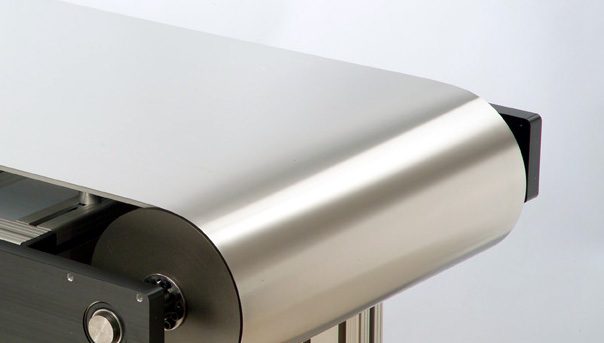
Our flat metal conveyor belts are made from a single sheet of high-end stainless steel.

Mesh or Flat Metal Belts: Which Do I Need?

retrofit metal conveyor belts
The smooth finish of flat metal conveyor belts ensures there are no unwanted marks or dents on finished products.

Flat metal belts are durable and easy to clean. Their resistance to high heat makes them a great choice for applications using elevated temperatures. Unlike mesh metal belts, our flat metal conveyor belts are made from a single sheet of high-end stainless steel. Endless metal conveyor belts from Belt Technologies have a flat, even surface, which makes them ideal for applications that need a smooth product finish.

Mesh belts are another form of metal conveyor belt often used in high-heat applications. They are made of links, or metal weaves that allow the passage of fluids or air. While popular, the challenges and shortcomings of mesh belts can be detrimental to a production line. Hundreds or even thousands of links mean hundreds of difficult-to-clean recesses, making mesh belts a haven for contamination. Any misalignment of a mesh belt can result in damage to individual wires and links, making the risk for belt failure or damage to product significantly higher and increasing the potential for downtime. As demonstrated in this specific instance, the textured surface of a mesh belt can also result in damaged product that must be reworked or scrapped altogether. An upgrade to an endless, solid metal belt can eliminate many of the expensive risks associated with mesh belted conveyors.

Avoid Complete System Replacement with Affordable Retrofit Solutions from BTI

Belt engineers worked with the customer to design a new, flat metal conveyor belt that would easily integrate into the existing conveyor system. The new belt was made with 301 full hard-tempered stainless steel able to withstand the high temperatures required for the operation. The flat surface will not leave any marks on the extruded plastic as it cools.

With a retrofit solution from Belt Technologies, the customer was able to avoid the cost of replacing the entire system and can now achieve the smooth product results they needed. Is your existing conveyor system letting you down? Call or request a quote today and let our experts help find a solution!