Belt Technologies Logo

Automated Food Processing With Stainless Steel Conveyor Belts


Stainless steel conveyor belt systems are ideal for the cooking, freezing, and handling of edible products. They are versatile and can easily be customized for any automated food processing system with exceptional results.

Metal conveyor belts do not outgas and do not require lubrication, which means there is no risk to the flavor or quality of the foods being processed. Unlike other conveyor materials, like wire mesh, fabric, or rubber, metal belts will not deteriorate or generate particulates that could contaminate food products.

Endless metal belts have a flat, nonporous surface and will not absorb bacteria. Conveyor systems from Belt Technologies are easy to sanitize between uses. They are resistant to chemical corrosion and can be sanitized with almost any standard cleaning method.

Metal belts can easily transition between hot and cold applications. They last longer and are more reliable than plastic conveyor belts in extreme temperatures. Stainless steel belts are excellent for cooking and handling raw materials because of their high thermal conductivity. Food is cooked thoroughly and evenly thanks to the quick, even transference of heat.

To learn more about stainless steel conveyor belt systems for automated food processing applications, contact the experts at Belt Technologies today.

Belt Technologies to Exhibit at 2017 Food Processing Expo in Chicago

AGAWAM, MA, August 2017—Belt Technologies, a world-class producer of stainless steel belts and conveyor systems, will be exhibiting at this year’s annual Process Expo, which will be held in Chicago from September 19–22. Belt Technologies will attend the food processing and packaging event to showcase their high-quality, stainless steel automation solutions.

“Process Expo is the nation’s largest food processing and packaging trade show,” says Ivan Amaya, Sales and Marketing Manager | Americas at Belt Technologies. “Attending as an exhibitor will be an exciting opportunity to demonstrate the many ways our stainless steel conveyor belt systems are ideal for the food processing industry.”

Belt Technologies will be demonstrating a variety of automation applications for stainless steel belts, including vacuum conveyors, stainless steel conveyor belts, timing belts, drive tapes and more. Attendees who stop by booth 2581 will be able to learn about the inherently beneficial properties of stainless steel conveyor systems, such as resistance to microbial adhesion and high tolerance to extreme temperatures, directly from both Ivan Amaya and Sales Engineer Scott MacDougall.

The event is anticipated to bring in 15,000 attendees representing every sector of the food and beverage manufacturing industry. Process Expo is a major networking event for CEOs, corporate managers, production and operations managers, quality assurance inspectors, engineers, chefs, and others within the food processing industry. Events will include live demonstrations, shows, contests, and exhibits. To learn more, visit the Process Expo event and Belt Technologies.

Read the original press release, here.

Metal Conveyor Belt for a Vapor Deposition Process in High Vacuum

Belt Technologies, Inc. has been contacted by several customers specializing in manufacturing advanced vacuum deposition equipment. The machinery they develop is typically used to deposit micrometer- to nanometer-thin, functional coatings on materials such as glass, metal strips, wafers, and polymer films. These materials are typically used in products like solar panels, architectural glass, and smartphone displays.

Designing a Conveyor Belt for Micrometer and Nanometer Vapor Deposition

For this particular application, the customers usually seek a series of belts, pulleys, and timing elements. The belts are to be run in pairs, carrying a product to a high-vacuum chamber for a vapor deposition process.

Vapor deposition is a precise process used to coat products with a layer of material. These coatings are often extremely thin; the vapor deposition process can be used to deposit the material atom-by-atom or molecule-by-molecule. It is typically used for coating exceptionally sensitive materials and equipment. To be successful, the vapor deposition process requires a high-vacuum environment with zero risk of contamination.

No Room for Error: Stainless Steel Is Clean, Precise and Reliable

Once the material reaches the vacuum chamber and the chamber is closed, there is no room for adjustment if the belt tracks off course or the material shifts in transit. Therefore, it is necessary that the motion profile of the belt be reliably precise. The belts also have to be exceptionally clean in order to prevent contamination. Anything that could potentially cause a delay in production, such as belt realignment, maintenance, or decontamination would cost up to several thousand dollars an hour in lost production time.

Stainless steel is an ideal material choice for applications requiring cleanliness and accuracy. Metal belts made of stainless steel do not require lubrication, do not outgas, and do not generate particulates. They are excellent for clean room applications and high-vacuum environments. To ensure the product would be transported safely and would not slip on the belt, our team added attachments to the belt design.

Timing Elements Ensure Accurate, Repeatable Results

The customer’s equipment design requires a timing element to keep production running smoothly. Our team provides the client with metal conveyor belts fitted with custom attachments to keep the product in place; we also use timing pulleys to provide maximum accuracy. The timing pulleys are configured with specially designed evacuation holes around each timing element. This prevents air from getting trapped behind the timing ball and helps to avoid any interruption to the vacuum conditions inside the chamber.

The engineers at Belt Technologies, Inc. have the knowledge and capability to provide custom stainless steel conveyor belt solutions for virtually any application. Contact us today and find out how metal belts can improve your automated conveyor system.

Stainless Steel Conveyor Belt Solution for Manufacturing Components with Sharp Metal Fragments

A distributor recently reached out to Belt Technologies on behalf of a small manufacturer in Europe. The manufacturer operated an automated system for punching steel and aluminum sheet metal to create components for its own customers. Once punched from the sheets, the metal pieces fell onto a conveyor belt for transportation, which is why they contacted our experts at Belt Technologies.

Inadequate Belt Materials Are Short-Lived and Require Frequent Replacement

The original conveyor belt used to transport the metal fragments was made of rubber. Unfortunately, the impact from the sharp metal fragments often damaged the easily impressionable rubber belt. Frequent cuts, tears, slices, and holes in the belt meant the belt had to be replaced too often, which cost the manufacturer time and money.

Stainless Steel Is Strong and Resilient to Physical Impact

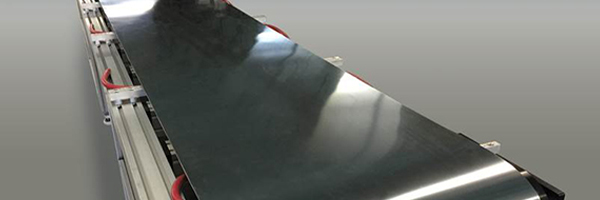
Our team worked closely with the distributor to obtain the details of the end user’s application. A stainless steel conveyor belt was clearly the best option for transporting sharp metal. Our engineers recommended a simple, solid, metal friction drive belt to catch and transport the metal fragments.

Stainless steel is robust and able to withstand impact damage and scratches. Although a stainless steel conveyor may appear more expensive in the short term, its long lifespan and resilience would help the manufacturer avoid costly replacements and downtime for maintenance.

Longer Belt Lifespan Increases Production Volume

Rubber belts are attractive for their low upfront cost, but the frequent need for replacement can become expensive. Stainless steel conveyor belts have a long lifespan, enabling manufacturers to maximize product throughput and increase overall efficiency. Our engineers strive to develop cost-effective solutions to virtually any automated system issue. For this customer, the answer was a simple switch in materials. At this point, the stainless steel belt is installed and has proven to be an excellent fix for the problem.

Would your automated manufacturing system benefit from the resilience and strength of a stainless steel conveyor belt? Contact the experts at Belt Technologies, Inc. today.